Public vs private blockchains: a notebook in every house, or a notebook behind a fence
A public blockchain lets anyone read it, write to it and keep a copy. A private, or permissioned, blockchain lets in only members it has approved, so you trust the members instead of the crowd.
In the crypto village, every house keeps a copy of the notebook. Anyone can build a house, open the notebook, and check every page. Nobody hands out invitations, and nobody can tear out a line.
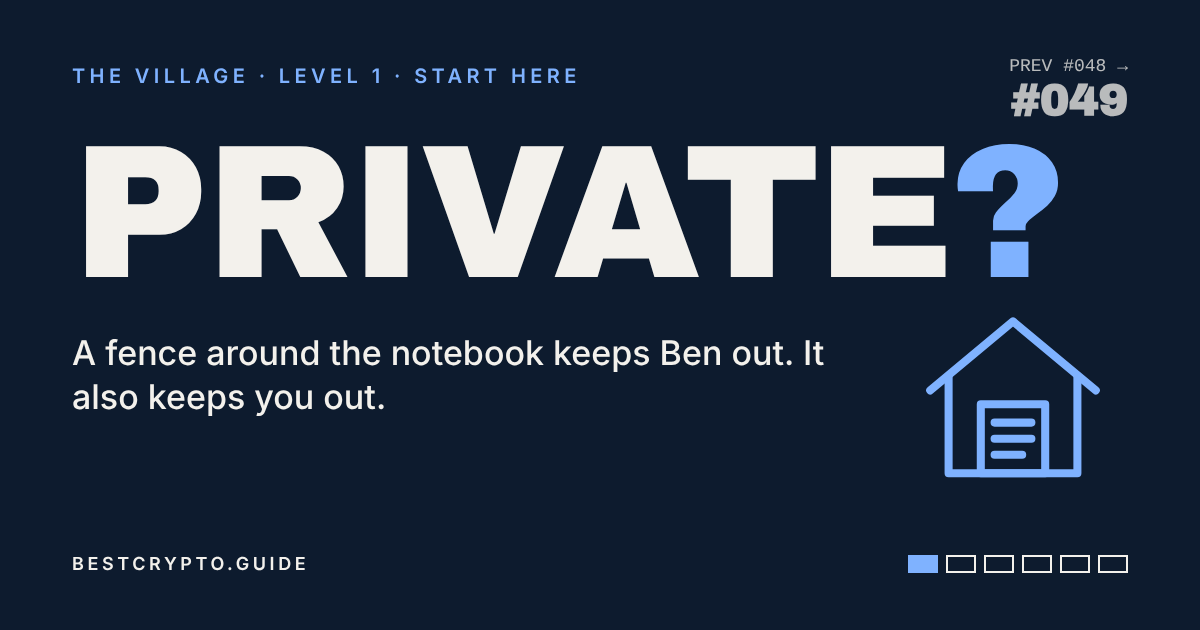
The big houses on the hill like the idea of a shared notebook. They don't like the idea of Ben reading it. So they build their own: same kind of notebook, same copies in every member's house, but behind a fence with a guard at the gate.
That's the difference between a public and a private blockchain. One asks nobody's permission. The other asks for your name first.
What it is
A public blockchain, like Bitcoin, is open to everyone. Anyone can read it, send transactions, keep a full copy and, with the right equipment, help write new blocks. The white paper puts it simply: nodes "can leave and rejoin the network at will" (Nakamoto, 2008).
A private blockchain, usually called permissioned, only lets in members who have been approved. Hyperledger Fabric, one of the best-known toolkits for building them, says of itself that it is "private and permissioned", and that its members "enroll through a trusted Membership Service Provider" (Hyperledger Fabric). In village terms: the guard keeps a list.
How it works: two real fences
Two documented cases show what a permissioned ledger looks like in practice.
- A bank's own notebook. JPMorgan runs the JPM Coin System. Its developer documentation calls it "a permissioned blockchain system that functions as a payment rail and deposit account ledger". It lets "participating J.P. Morgan clients" move money held on deposit with the bank (J.P. Morgan). On 6 November 2024, the bank said its blockchain unit, renamed Kinexys, had passed $1.5 trillion in notional value since it began, and was processing more than $2 billion a day on average in 2024 (J.P. Morgan, 2024). Those are the bank's own figures. You can't check them, because you're not on the list.
- The keepers of keepers. Project mBridge was a test run by the Bank for International Settlements' Innovation Hub with the central banks of Hong Kong, Thailand, China and the United Arab Emirates. Over six weeks in 2022, 20 commercial banks made over 160 payment and currency-exchange transactions worth more than $22 million (BIS, 2022). The report is clear about who held the pen: "At the core of the mBL are the central banks, who each run a validating node". Validation was "reserved to permissioned entities, ie the central banks", and the commercial banks connected through their own central bank (BIS Innovation Hub, 2022).
Count the houses with a pen. In mBridge, four central banks. On Bitcoin, anyone who mines. That's the whole difference, in one number.
Why it matters
- Who you trust changes. On a public chain, you trust that no single group controls most of the writing power. On a permissioned chain, you trust the members and whoever decides who gets in.
- Mistakes can be fixed, and so can the books. A small group of known members can agree to correct an entry. That's useful when a clerk types a wrong number. It's the same power that makes the notebook less tamper-proof.
- Privacy is easier. Banks don't want competitors reading their customers' payments. A fence helps. On a public chain like Bitcoin, every transaction is visible to everyone.
- Speed is easier too. Four known validators can agree faster than thousands of strangers. We explain why public chains are slow on purpose in "Why blockchains are slow on purpose".
- You usually can't join. A permissioned ledger isn't for Grandma Rosa. It's for banks, firms and governments that already know each other.
Where people get it wrong
- "Private blockchain means the same thing as Bitcoin, just smaller." The software may look similar. The trust model is the opposite: approved members instead of anyone.
- "Permissioned means secret." Not necessarily. It means someone controls who can join and what they may do. Who can read what is up to the members' rules.
- "A private blockchain can't be changed." If all the members agree, they can change it. There's no crowd of strangers to object.
- "Public means anyone can see my name." Public chains show addresses and amounts, not names. Once an address is linked to you, though, its history is readable.
- "One is good, the other is bad." They answer different questions. A public chain is for people who don't trust each other. A permissioned one is for people who mostly do.
Ask who's on the list
When a company says it "uses blockchain", ask one question: can I run a copy myself? If the answer is no, it's a permissioned ledger, and the real question is who keeps the guest list.
Grandma Rosa asked that at the gate of the big house. The guard said she wasn't on it. "Then it's not my notebook," she said, and went home to the one she can read.
Frequently asked questions
What is the difference between a public and a private blockchain?
A public blockchain lets anyone read it, send transactions and keep a copy without asking permission. A private, or permissioned, blockchain only admits approved members, who are identified before they join. You trust the crowd in one case and the members in the other.
Is Bitcoin a public or private blockchain?
Bitcoin is a public blockchain. Anyone can download the software, keep a full copy of the ledger and check every transaction. Nobody approves new participants.
What is a permissioned blockchain used for?
Mostly by banks, companies and central banks that want a shared record among known partners. Examples include JPMorgan's JPM Coin System and the central bank test Project mBridge, where each participating central bank ran a validating node.
Are private blockchains more secure?
Not in the same way. They are protected by the identity and honesty of a small group of members, not by thousands of independent copies. If enough members agree, they can change the record.
Can I see what happens on a private blockchain?
Usually not. Access depends on the members' rules. Figures about activity on a permissioned ledger generally come from its operator and can't be checked independently by outsiders.
Sources
- Hyperledger Fabric documentation (release 2.5), Introduction
- J.P. Morgan Payments developer documentation, JPM Coin System
- J.P. Morgan, Introducing Kinexys (6 November 2024)
- BIS Innovation Hub, Project mBridge: connecting economies through CBDC (October 2022)
- BIS, Project mBridge: connecting economies through CBDC (summary page, 26 October 2022)
- Satoshi Nakamoto, Bitcoin: A peer-to-peer electronic cash system (2008)