Quantum computing and crypto: the real risk is visible keys and a slow move, not broken seals
A large quantum computer running Shor's algorithm could work out private keys from public keys, while Grover's algorithm only weakens hashes. The real risk is coins whose public keys are already on the ledger, and how long it takes to move everyone to new signatures.
Grandma Rosa has read about quantum computers and wants to know one thing: should she take her coins out of the notebook and bury them in the garden?
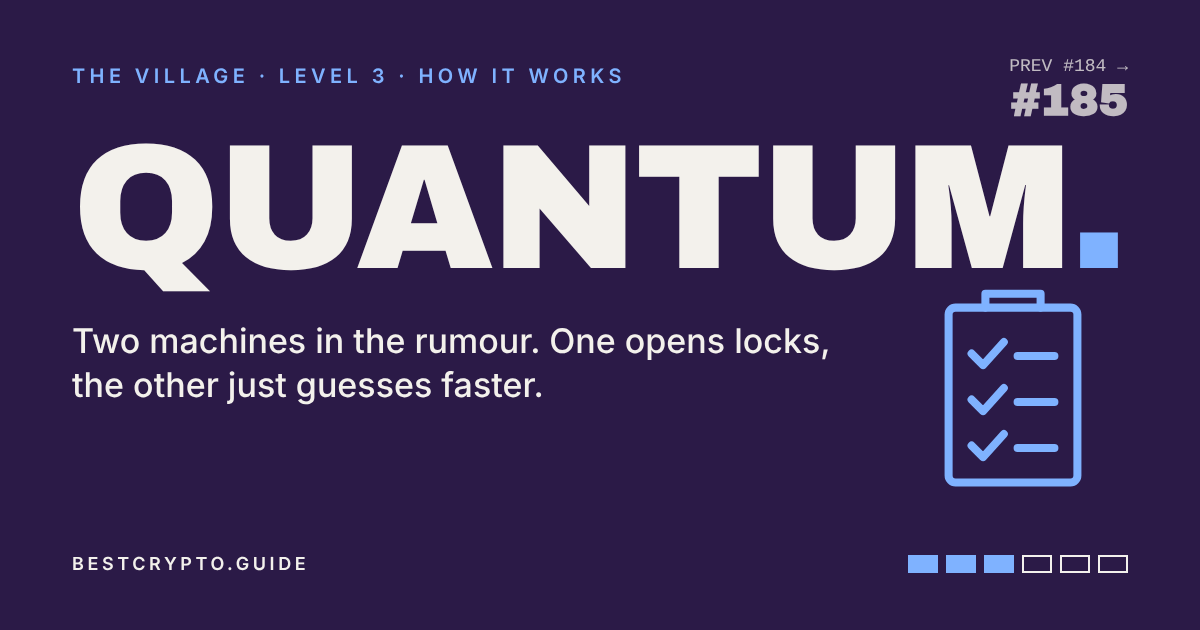
Anna explains that the rumour is really about two different machines. One could open a certain kind of lock if it can see the lock's shape. The other can't open anything. It only helps a thief guess faster at the wax seals, and not by enough to matter.
That's the calm version of the quantum story. The seals on every page are fine. The danger is to signature locks whose public key is already visible, and the real work is moving millions of coins to new locks before anyone builds the first machine.
What it is
Quantum computing threatens crypto through two published algorithms, and they are not equal.
Shor's algorithm solves discrete logarithms, the problem behind elliptic-curve keys, in "a number of steps polynomial in the input size" on a quantum computer (Shor, arXiv). In plain words: it turns a public key back into the private key. NIST's transition report says ECDSA, EdDSA and RSA "are vulnerable to Shor's Algorithm on a cryptanalytically relevant quantum computer" (NIST IR 8547).
Grover's algorithm speeds up blind searching: a list of N items can be searched in about the square root of N steps (Grover, 1996). That's a real speed-up, but a modest one. NIST's report rates symmetric cryptography and hash functions as "significantly less vulnerable to known quantum attacks than the public-key cryptography standards".
How it works
Put numbers on both machines.
- Grover against a seal. To find a page that matches a SHA-256 seal by guessing, a normal computer needs up to 2 to the power of 256 tries. Grover's square root brings that to 2 to the power of 128. That's still a number with 39 digits. The seal survives.
- Shor against a lock. For Bitcoin's curve, researchers from Google Quantum AI, UC Berkeley, the Ethereum Foundation and Stanford estimated in March 2026 that the attack needs no more than 1,200 logical qubits and "can execute in minutes using fewer than half a million physical qubits" under their hardware assumptions (Babbush et al., 2026). Minutes, not centuries. The machine is the missing piece.
- Which locks are visible. The draft proposal BIP 360 splits the danger in two (BIP 360). "Long exposure" attacks target keys already on the ledger: it lists "P2PK outputs (e.g. Satoshi's coins, CPU miners)", reused outputs and Taproot outputs starting with bc1p. "Short exposure" attacks target the key you reveal when you spend from a hashed address, and "require faster quantum computers", because the thief must finish before your payment is confirmed.
So the order of danger is clear. First the old coins and reused addresses, whose keys are public for years. Then the moment of spending, but only once machines get fast.
Why it matters
- The fix exists on paper. On 13 August 2024, NIST published FIPS 203 for encryption and FIPS 204 and FIPS 205 for digital signatures (NIST, 2024). NIST will "deprecate all quantum-vulnerable digital signature algorithms after 2030" and lists ECDSA as disallowed after 2035 in its own standards.
- Bitcoin needs a rule change first. New signature types arrive by soft fork. BIP 360, created on 18 December 2024, is one proposal, and its status on 19 November 2026 was Draft.
- Then everyone has to move. A new lock only protects coins sent to it. Every owner has to make a transaction, and every page of the notebook has limited room.
- Lost coins can't move. Coins whose keys are gone will sit behind visible locks forever. Whether the village should freeze them, or leave them for whoever builds the machine first, is a fight nobody has settled.
Where people get it wrong
- "Quantum breaks all cryptography." Shor breaks public-key schemes. Against hashes, Grover only halves the effective strength, counted in bits.
- "Mining will be taken over overnight." Mining is a hash search, Grover's territory. A square-root speed-up is real but limited, and it's the signatures that face Shor.
- "Harvest now, decrypt later applies to my bitcoin." NIST's phrase is about encrypted data that's collected for later. Bitcoin has nothing encrypted on the ledger. Its version of the problem is public keys that are already harvested by being public.
- "A quantum-safe coin is the answer." A different coin doesn't move your existing coins anywhere. The fix is a new lock on the same notebook.
Stop showing your lock
The one quantum risk you control is address reuse. Check that your wallet gives you a new address for every payment, and move any coins sitting on an address you have already spent from. It costs a fee and five minutes, and it also helps your privacy. One exception: Taproot addresses, starting bc1p, show their key from the start, so a fresh one doesn't hide it.
As for burying coins in the garden: you can't bury a line in a notebook. And the stranger at the gate selling "quantum-proof" shovels is the only thing in this story that already exists.
Frequently asked questions
What is the real quantum risk to Bitcoin?
A large quantum computer running Shor's algorithm could work out private keys from public keys. Coins whose public keys are already visible, such as early pay-to-public-key outputs, reused addresses and Taproot outputs, are most exposed. Hashes and the block chain itself are much less affected.
What is the difference between Shor's and Grover's algorithms?
Shor's algorithm solves factoring and discrete logarithms efficiently, which breaks RSA and elliptic-curve signatures. Grover's algorithm speeds up unstructured searches to about the square root of the work. That weakens hashes and symmetric ciphers, but far less, so NIST rates them as significantly less vulnerable.
Can quantum computers break SHA-256?
Not in any practical sense on current understanding. Grover's algorithm would cut a brute-force search of 2 to the power of 256 down to about 2 to the power of 128 steps, which is still far beyond reach. NIST rates hash functions as significantly less vulnerable than public-key cryptography.
What has to happen for Bitcoin to become quantum-safe?
Bitcoin needs new signature or output types through a soft fork, and then owners must move their coins into them. BIP 360 is one draft proposal, created on 18 December 2024. NIST published post-quantum signature standards FIPS 204 and FIPS 205 on 13 August 2024.
How can I reduce my own quantum risk?
Don't reuse addresses. A new address for each payment keeps your public key hidden until you spend. If you have coins on an address you have already spent from, moving them to a fresh address reduces your exposure.
Sources
- Peter W. Shor, Polynomial-time algorithms for prime factorization and discrete logarithms on a quantum computer (arXiv quant-ph/9508027)
- Lov K. Grover, A fast quantum mechanical algorithm for database search (arXiv quant-ph/9605043, 29 May 1996)
- NIST, IR 8547, Transition to Post-Quantum Cryptography Standards (October 2026)
- NIST, NIST releases first 3 finalized post-quantum encryption standards (13 August 2024)
- Babbush, Gidney, Boneh, Drake and others, Securing Elliptic Curve Cryptocurrencies against Quantum Vulnerabilities (IACR ePrint 2026/625)
- BIP 360, Pay-to-Merkle-Root (P2MR), status Draft, created 18 December 2024