ERC-20 tokens explained: your token is a row in someone else's list
An ERC-20 token is a list of balances kept inside one smart contract, with a standard set of functions to read and move them. Your wallet doesn't hold the token; it reads your row in that contract's list. The name on it can be copied by anyone, so the contract address is what counts.
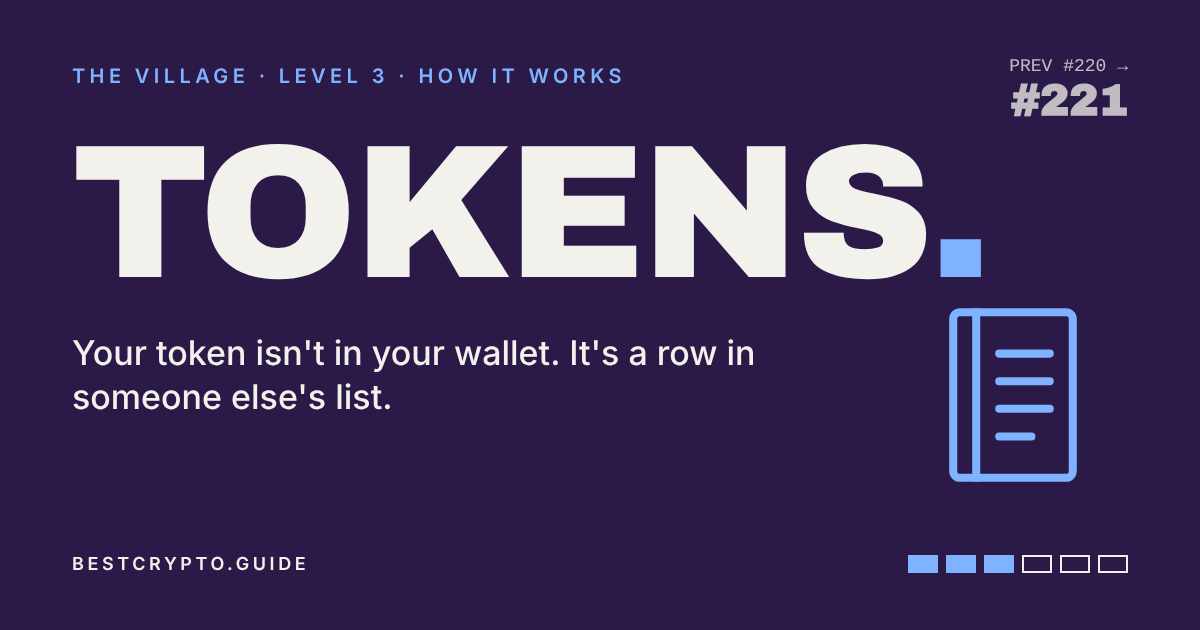
Some pages of the village notebook aren't about ether at all. The baker's page says: "Bread vouchers. Anna: 12. Rosa: 3. Ben: 0." Hand a voucher on, and the baker's rule moves one from your line to the next.
Rosa thinks her vouchers sit in her purse. They don't. They sit on the baker's page, and her purse only knows where to look.
That is an ERC-20 token: a list of balances kept inside one contract, with a standard set of buttons to read and move them. Thousands of pages use the same buttons, so every wallet knows how to read them all.
What it is
ERC-20 is a standard, not a coin. Its document, EIP-20, was created on 19 November 2015 by Fabian Vogelsteller and Vitalik Buterin, and its summary is four words: "A standard interface for tokens." It "provides basic functionality to transfer tokens, as well as allow tokens to be approved so they can be spent by another on-chain third party" (EIP-20).
A contract that follows it is an ERC-20 token. Ether itself isn't one: ether lives in the balance field of every account (ethereum.org), while a token lives in one contract's storage.
How it works
EIP-20 lists the buttons every token must offer:
- totalSupply: "Returns the total token supply."
- balanceOf: the balance of one address, a row in the list.
- transfer and transferFrom: move tokens, and "MUST fire the Transfer event", a public note every explorer reads.
- approve and allowance: let another address spend up to a limit from your row. That permission has its own article, "Token approvals", and it deserves one.
- name, symbol and decimals: marked "OPTIONAL". The standard says other contracts "MUST NOT expect these values to be present".
Decimals deserve a worked example. The list stores only whole numbers. EIP-20 explains: decimals of 8 means you divide the stored number by 100,000,000 to get what users see. Two tokens, read on Etherscan on 19 November 2026 (examples, not recommendations):
- USDC uses 6 decimals (Etherscan). A row holding 1,500,000 shows as 1,500,000 / 10^6 = 1.5 USDC.
- Wrapped Ether (WETH) uses 18 decimals (Etherscan). The same stored 1,500,000 would show as 0.0000000000015 WETH. To show 1.5 WETH, the row must hold 1,500,000,000,000,000,000.
- The row count. Etherscan counted 9,157,833 holder addresses for the USDC contract that day. That's 9,157,833 lines on one contract's page, not 9 million coins sitting in 9 million wallets.
Get the decimals wrong in a program and you're off by a factor of a trillion. Your wallet does the division for you; it just has to read the right number from the right contract.
Why it matters
- One standard, every wallet. Because every ERC-20 contract has the same buttons, wallets and exchanges can show any token without new code.
- The contract's rules are the token's rules. Can someone create more? Freeze your row? Pause transfers? The standard doesn't say. The contract's own code does. The USDC contract on Etherscan, for example, is a proxy whose code can be pointed at a new version.
- Anyone can make one. Creating a token takes one contract. A token existing tells you nothing about whether anyone stands behind it.
Where people get it wrong
- "The token is in my wallet." Your wallet holds the key to your address. The balance is a row in the token contract, and the contract decides what that row can do.
- "If it shows up in my wallet, it's real." Anyone can write a contract with any name and symbol and send rows to your address. Name and symbol prove nothing.
- "All tokens have 18 decimals." Many do, some don't. USDC has 6.
- "Ether is an ERC-20 token." It isn't. It's the network's own coin; wrapped ether is a token that represents it.
Check the contract, not the name
When a token appears in your wallet, or someone tells you to buy one, look up the contract address on a block explorer. Compare it with the address the issuer publishes on its own official site. Same name, different address means a different token.
The stranger at the gate has a voucher page too. It says "Bread vouchers" at the top. The baker has never heard of it.
Frequently asked questions
What is an ERC-20 token?
An ERC-20 token is a smart contract on Ethereum that keeps a list of balances and follows the EIP-20 standard, so that wallets and apps can read and move it in the same way. The standard was created in November 2015 by Fabian Vogelsteller and Vitalik Buterin.
Where are my ERC-20 tokens actually stored?
They are stored as a balance next to your address inside the token's own contract. Your wallet holds the key that can move that balance and reads the number from the contract.
What are token decimals?
Token contracts store balances as whole numbers, and the decimals value says where the decimal point goes for display. With 6 decimals, a stored 1,500,000 shows as 1.5; with 18 decimals, 1.5 tokens are stored as 1,500,000,000,000,000,000.
Can two tokens have the same name?
Yes. The name and symbol are just text that the contract's creator chooses, so anyone can copy them. Only the contract address tells two tokens apart.
Is ether an ERC-20 token?
No. Ether is Ethereum's native coin, held in the balance field of every account. ERC-20 tokens are separate contracts; wrapped ether (WETH) is an ERC-20 token that represents ether one to one.