Can you still mine at home? You can, but at EU prices the meter wins
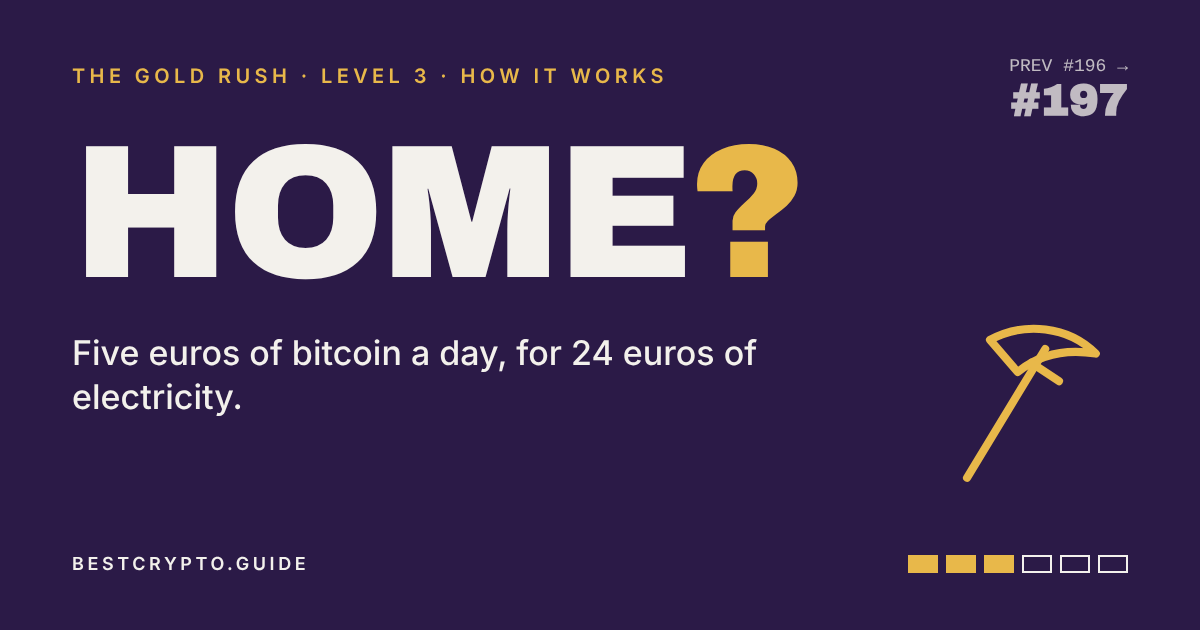
Yes, anyone can plug in a mining machine. With one modern machine, the network difficulty of 14 November 2026 and the EU average household electricity price, it earns about 5 euros a day and burns about 24 euros of power.
In the first days of every gold rush, a man with a pan could find gold in the creek. Then the companies came with dredges and hydraulic hoses, and the man with the pan was left with gravel.
Bitcoin went the same way. Today its creek is worked by warehouses full of machines built for nothing else.
So can you still mine at home? Yes. Nobody stops you. But do the arithmetic first, because the electricity meter does it whether you do or not.
What it is
Mining at home means running a mining machine (an ASIC, a chip built only to compute Bitcoin's hash) on your own power. The machine guesses numbers. The network pays a block reward to whoever finds a winning guess first.
Your share of the rewards is your share of all the guessing. That's the whole calculation. Everything else is detail.
How it works
Take one real, widely sold machine and three dated numbers. The machine is an example, not a recommendation.
The machine. Bitmain's own spec sheet for the Antminer S21 gives 200 terahashes per second (TH/s) at 3,500 watts at the wall, which is 17.5 joules per terahash (Bitmain).
The network. Block 975,744, mined on 14 November 2026, set the difficulty at 134,823,837,323,272.7 (mempool.space). Difficulty times 2 to the power 32, divided by 600 seconds, gives the hash rate the network needs for a block every ten minutes: about 965 exahashes per second. An exahash is a million terahashes.
The power price. Eurostat puts the EU average household electricity price for the first half of 2026 at €0.28 per kilowatt-hour, taxes included (Eurostat, 30 October 2026).
Now the sums.
- Your share. 200 TH/s out of about 965 million TH/s is 0.000021% of the network.
- Blocks. The network finds 144 blocks a day. Your share of them is 0.0000298 blocks a day.
- Bitcoin. At 3.125 bitcoin of new coins per block, that is about 0.0000933 bitcoin a day, or 9,325 satoshis. Fees add a little: block 975,744 itself carried under 0.02 bitcoin of them.
- Euros earned. At 18 November 2026 prices (CoinGecko, €56,980.95 per bitcoin), that day's value is about €5.31.
- Euros burned. 3.5 kilowatts for 24 hours is 84 kilowatt-hours. At €0.28, that's €23.52.
So the machine loses about €18 a day, or around €546 a month. It would break even at about €0.063 per kilowatt-hour, less than a quarter of the EU household average. Ireland, Germany and Belgium sit at €0.36 to €0.39 in the same Eurostat release.
And that's before you have paid for the machine.
Why it matters
The shovel sellers know these numbers too. They are paid when the machine is sold, whatever it earns on your electricity contract afterwards.
For the network, home miners are a good thing: more independent people guessing makes it harder for a few firms to dominate. For your wallet, the gap between €5 and €24 a day doesn't care about principles.
Two more costs don't show in the sum. The machine turns all 3,500 watts into heat and noise, like a fan heater that never stops. And Bitmain's sheet lists 220 to 277 volts with 20 amps of input current, which is a question for an electrician, not a power strip.
Where people get it wrong
- "I'll mine solo and keep the whole block." Your chance of finding any one block is about 1 in 4.8 million. On average you would wait about 92 years for one, and the average hides that you might never find it.
- "A pool fixes the losses." A pool smooths your income into small daily payments. It doesn't change the expected total, and it takes a fee.
- "Heating my home with it is free." It is electric heating at €0.28 a kilowatt-hour with a small bitcoin rebate. Only compare it with the heating you would otherwise use.
- "The price will go up." Maybe. So will the difficulty, every 2,016 blocks, if more machines join. Nobody can promise you which wins.
- "Cloud mining avoids all this." Then someone else pays the power and charges you for it, with a margin. Check who runs the machines before you send anything.
Do your own sum before you buy
Before you buy a machine, find three numbers: its terahashes and watts from the maker's spec sheet, the network difficulty from a block explorer, and the price per kilowatt-hour on your own bill. Multiply it out as above.
If your electricity costs more than about six cents a kilowatt-hour, the only reliable profit in home mining goes to the man who sold you the pan.
Frequently asked questions
Is it profitable to mine bitcoin at home?
At EU household electricity prices, generally no. One 200 TH/s machine earned about €5.31 a day at the difficulty of 14 November 2026 and 18 November 2026 prices, while using about €23.52 of power at the EU average of €0.28 per kilowatt-hour.
How much electricity does a bitcoin miner use?
A modern ASIC such as the Antminer S21 draws 3,500 watts according to Bitmain's spec sheet. Running all day, that is 84 kilowatt-hours, and almost all of it ends up as heat in the room.
What are the odds of mining a bitcoin block solo?
With 200 TH/s at the difficulty set by block 975,744 on 14 November 2026, the chance of finding any one block was about 1 in 4.8 million. That works out at one block every 92 years on average, with no guarantee of ever finding one.
Does joining a mining pool make home mining profitable?
No. A pool turns rare large rewards into small regular payments, but the expected amount stays the same, minus the pool's fee. It doesn't lower your electricity bill.
What electricity price makes home mining break even?
For an Antminer S21 at the difficulty of 14 November 2026 and 18 November 2026 prices, the break-even was about €0.063 per kilowatt-hour, ignoring the cost of the machine. Difficulty and the bitcoin price both move, so the break-even moves with them.