What miners earn: block reward plus fees, one paid by the code and one by the crowd
A Bitcoin miner earns the block reward: the new coins the code allows (3.125 bitcoin per block since April 2024) plus the fees of every transaction in the block. The subsidy is fixed by block height, the fees swing with demand, and neither can be spent until 100 more blocks are built on top.
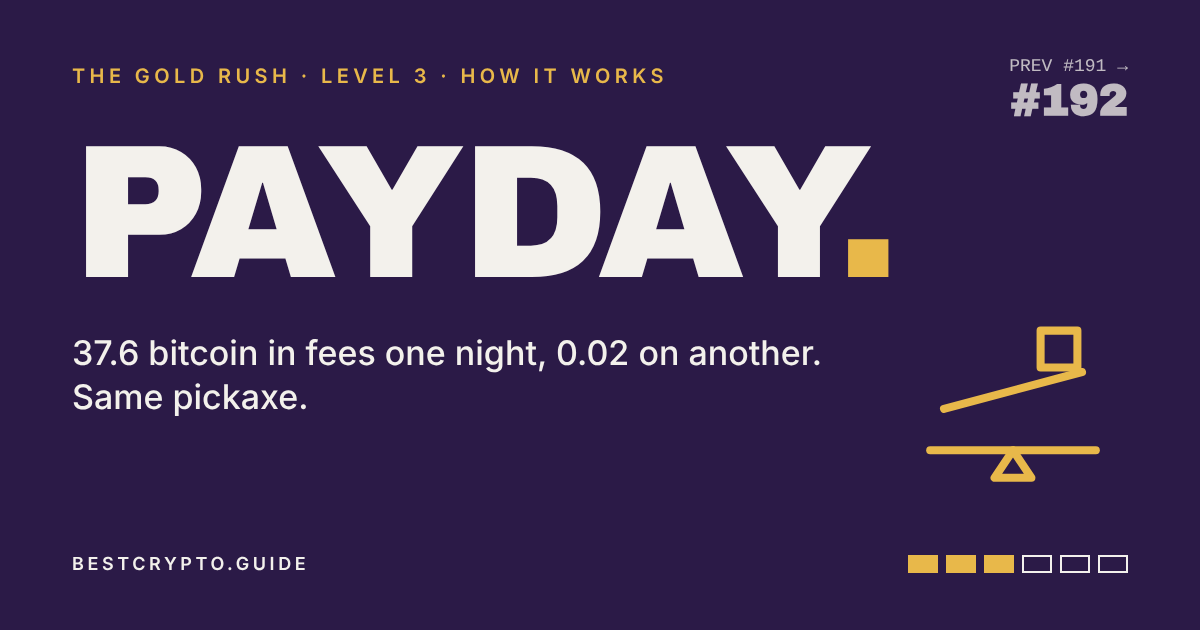
A prospector who struck gold was paid twice. Once by the ground, in whatever the creek gave up. And once by the crowd, when everyone in town suddenly needed what he had, at whatever price he could ask.
A Bitcoin miner is paid the same two ways. The code hands over a fixed number of new coins for every block. The crowd adds fees, and the crowd is fickle: some nights it pays a fortune to get in, other nights almost nothing.
Together they make the block reward. The first half is predictable to the block. The second half is anybody's guess. Here is how much each was worth in two real blocks.
What it is
The block reward is everything the miner of a block may pay itself. It has two parts. The block subsidy is the new bitcoin the code allows: 50 at the start, halving every 210,000 blocks, 3.125 since block 840,000 (validation.cpp). The fees are what senders attached to their transactions, which go to whoever includes them in a block.
The miner collects both in one place: the coinbase transaction, the first in every block. The white paper calls it "a special transaction that starts a new coin owned by the creator of the block" (Nakamoto, 2008). How fees are set is in "Bitcoin fees explained".
How it works: a feast and a quiet night
All figures are read from the blocks through the mempool.space explorer.
The feast: block 840,000, 20 April 2024, 00:09:27 UTC. The halving block. Its subsidy had just fallen to 3.125 bitcoin. Its fees came to 3,762,561,499 satoshis, or 37.63 bitcoin (mempool.space).
- Total reward: 4,075,061,499 satoshis = 40.75 bitcoin.
- Fee share: 37.63 / 40.75 = 92.3%.
Four minutes earlier, block 839,999 paid 6.25 bitcoin of subsidy and 1.04 bitcoin in fees, a fee share of 14.3%. The subsidy halved, and on that one block the crowd paid more than ten times the code.
The quiet night: block 975,744, 14 November 2026, 05:02:50 UTC. Same subsidy, 3.125 bitcoin. Fees: 1,988,041 satoshis, about 0.0199 bitcoin (mempool.space).
- Total reward: 314,488,041 satoshis = 3.1449 bitcoin.
- Fee share: 0.63%.
Block 840,000 carried about 1,893 times the fees of block 975,744. The subsidy was identical. That is the whole story of miner income in one comparison: the code pays a flat wage, the crowd pays tips that swing wildly.
Waiting for payday. Neither part can be spent at once. Bitcoin Core's rule: "Coinbase transaction outputs can only be spent after this number of new blocks", and the number is 100 (consensus.h). The reward of block 975,744 became spendable only once block 975,844 existed, roughly 16 to 17 hours later at ten minutes a block.
Hashprice: pay per unit of digging. Miners compare their income with a figure called hashprice: expected earnings per unit of hash rate per day. At block 975,744's difficulty of 134,823,837,323,272.66, one petahash per second (a thousand terahashes) expects about 0.000466 bitcoin a day from the subsidy alone. At 18 November 2026 prices (CoinGecko, USD 63,154.72 per bitcoin), that is about $29.45 per PH/s per day, plus whatever fees add. That is that day's value, and it moves every time the price, the difficulty or the fees do.
Why it matters
- In quiet blocks, the subsidy is almost everything. In block 975,744, fees were under 1% of the pay. Each halving cuts the bigger part in half.
- Fees are the long-term plan. The white paper says the incentive "can transition entirely to transaction fees" (Nakamoto, 2008). Whether fees will be enough is the subject of "What happens when the last bitcoin is mined?".
- Busy days pay miners, users pay for them. The feast at block 840,000 was paid by people who wanted their transactions in that block badly enough.
- Hashprice decides who keeps digging. Machines whose power costs more than their hashprice get switched off. "The economics of a mining farm" does those sums for real companies.
Where people get it wrong
- "Block reward and block subsidy are the same thing." The subsidy is the new coins. The reward is subsidy plus fees.
- "Miners set the fees." Senders choose what to pay. Miners only choose which transactions to include.
- "Fees are a big part of miners' pay." On some days, yes. In block 975,744, they were 0.63%.
- "Miners get paid straight away." The coinbase has to wait 100 blocks. If the block is replaced in a race, the reward is gone.
- "A miner can just pay itself more." Nodes reject a block whose coinbase claims more than subsidy plus fees.
Read a miner's payslip
On any block explorer, open a block and find the coinbase transaction. Subtract 3.125 from its total. The rest is fees. Do it for a block from a busy week and one from a quiet Sunday, and you'll see how much of the miners' pay depends on the crowd.
The saloon will tell you mining is a steady salary. The payslip says it's a fixed wage plus tips, and some nights the tip jar is empty.
Frequently asked questions
What do Bitcoin miners earn?
Miners earn the block reward: the block subsidy of 3.125 bitcoin per block since block 840,000 on 20 April 2024, plus the fees of all transactions in the block. Both are paid through the block's first transaction, the coinbase.
What is the difference between the block reward and the block subsidy?
The block subsidy is the new bitcoin created with each block, fixed by the block height. The block reward is the subsidy plus the transaction fees. The halving cuts only the subsidy.
How much of a miner's income comes from fees?
It varies a lot. In block 840,000 on 20 April 2024, fees were 92.3% of the reward. In block 975,744 on 14 November 2026, they were 0.63%.
When can a miner spend the block reward?
Only after 100 more blocks have been added on top, which takes roughly 16 to 17 hours at ten minutes per block. This rule protects the network if the block is later replaced by a competing one.
What is hashprice?
Hashprice is the expected income per unit of hash rate per day, often given in dollars per petahash per second. It depends on the difficulty, the subsidy, the fees and the bitcoin price, so it changes all the time.
Sources
- mempool.space API, blocks 839,986 to 840,000 (19 to 20 April 2024)
- mempool.space API, blocks 975,730 to 975,744 (14 November 2026)
- Bitcoin Core source code, src/validation.cpp (GetBlockSubsidy)
- Bitcoin Core source code, src/consensus/consensus.h (COINBASE_MATURITY)
- Satoshi Nakamoto, Bitcoin: A peer-to-peer electronic cash system (2008), section 6