Memecoins explained: scrip printed in the saloon, and the joke is the whole product
A memecoin is a token built around a joke, a character or a trend, with no business, no cash flow and no promise behind it. In the US, SEC staff said in February 2025 that such coins are generally not securities, which also means buyers get none of the protections securities law gives.
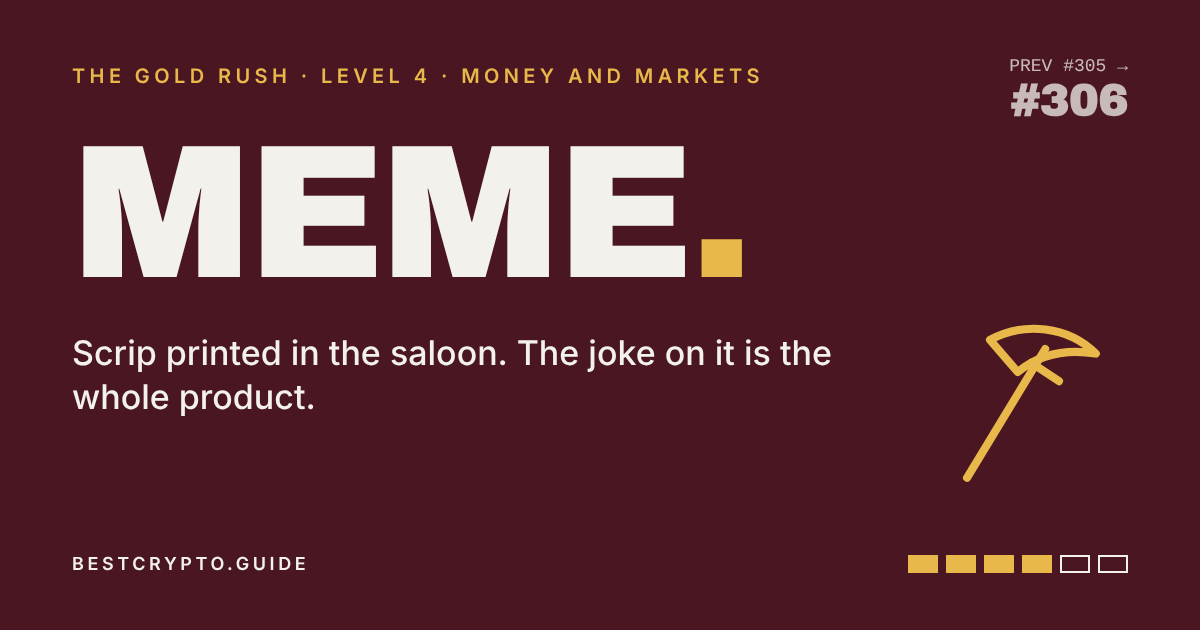
Picture a boomtown saloon with paper pinned to the walls. Most of it promises a mine somewhere. Some of it promises nothing at all, just a drawing and a joke, and people trade it anyway.
A memecoin is that second kind of paper. A dog, a frog, a slogan, a trending name. No mine behind it, no company, no promise.
That honesty is also the trap. Nobody can break a promise that was never made, so nobody owes you anything when the joke gets old.
What it is
A memecoin is a crypto token whose value rests on attention, community and humour rather than on any product. The US Securities and Exchange Commission's staff describe it as "a type of crypto asset inspired by internet memes, characters, current events, or trends" (SEC staff statement, 27 February 2025).
Dogecoin, the best-known early one, has its own article. This one is about the newer kind: tokens created in seconds on a launchpad, by anyone, for almost nothing.
How it works: a coin on a bonding curve
Take pump.fun on Solana, an example, not a recommendation. Its public documentation, read on 19 November 2026, describes how every new coin starts (pump.fun docs).
Each coin trades against its own contract, a bonding curve. There is no order book and no seller on the other side, just a formula "based on Uniswap V2" that uses synthetic, or virtual, reserves so there is always a price. The docs list the starting values:
- Total token supply: 1,000,000,000,000,000 base units.
- Virtual token reserve: 1,073,000,000,000,000 units, 107.3% of the supply. It is a bookkeeping number, not real tokens.
- Virtual SOL reserve: 30,000,000,000 lamports. At 1,000,000,000 lamports to the SOL (Solana Docs), that is 30 SOL.
- Tokens actually for sale on the curve: 793,100,000,000,000 units, or 79.31% of the supply.
The formula keeps tokens × SOL constant. Work it in percentages of supply: 107.3 × 30 = 3,219. The arithmetic from those figures, before fees:
- Buying the first 10% of the supply: the token reserve drops from 107.3 to 97.3, so the SOL reserve must rise to 3,219 ÷ 97.3 = 33.08. Cost: about 3.08 SOL.
- Buying the last 10% on the curve (from 69.31% sold to 79.31%): the reserve drops from 37.99 to 27.99, and the SOL side rises from 84.73 to 115.01. Cost: about 30.27 SOL.
- Buying everything on the curve: 115.01 minus the virtual 30, so about 85.01 SOL of real money.
The same 10% of a coin costs nearly ten times more at the end of the curve than at the start. The last price on the curve is about 14.7 times the first. When the curve sells out, the docs say "the liquidity from the bonding curve is migrated to PumpSwap", an automated market maker where the coin then trades like any other.
The docs describe fees as dynamic, depending on the coin's market value, and a share goes to the coin's creator. Read the current fee schedule before you trust any of the figures above.
Why it matters
The curve explains the whole business. Whoever buys first pays the least. Every later buyer pays more and, by buying, raises the price for the first. The early buyers' profit is the later buyers' money. There is no other source.
The sheriff looked at this and stepped back. SEC staff concluded that transactions in the meme coins they described "do not involve the offer and sale of securities". They added that fraud around meme coins "may be subject to enforcement action" by other agencies (SEC staff statement).
On 17 March 2026 the SEC, joined by the CFTC, put this in a formal interpretation, effective 23 March 2026. It sorts meme coins under "digital collectibles", which it says are not securities themselves (SEC press release; SEC and CFTC release). No registration, no prospectus, no required disclosure. The saloon prints freely, and buyers are on their own.
Where people get it wrong
- "It's only a joke, so nobody can cheat me." Insiders can still buy first, hype, and sell to you. That is a pump and dump, and it has its own article.
- "Not a security means approved." It means securities law doesn't apply. Nobody checked anything.
- "The curve guarantees I can sell." On the curve you sell back into a formula, at the falling price your own sale creates.
- "Early means safe." Early means cheaper. Somebody was always earlier.
- "Everyone in the chat is buying." The saloon is loud by design. Volume in a chat is not money in a pool.
Look at who bought first
Before you buy any memecoin, open it on a block explorer and look at the first buyers and the biggest holders. If a few wallets bought in the first seconds and still hold a large share, you know who is waiting to sell to you. The article on checking whether a token is a scam lists the rest.
The joke on the scrip is free. The punchline is paid by the last one in.
Frequently asked questions
What is a memecoin?
A memecoin is a crypto token built around an internet meme, character, trend or joke, with no product or business behind it. Its price depends almost entirely on attention and on how many new buyers arrive.
Are memecoins securities in the US?
In a statement of 27 February 2025, SEC staff said that the meme coins it described are generally not securities. A joint SEC and CFTC interpretation effective 23 March 2026 classes them as digital collectibles, while fraud can still be pursued under other laws.
What is a bonding curve?
A bonding curve is a formula in a smart contract that sets a token's price according to how many tokens have already been bought. On pump.fun the curve works like a Uniswap V2 pool with virtual reserves, so each purchase raises the price for the next buyer.
What happens when a pump.fun coin's bonding curve completes?
According to pump.fun's documentation, when a coin's bonding curve sells out, its liquidity is moved to PumpSwap, an automated market maker on Solana. From then on the coin trades in an ordinary pool.
Why do early memecoin buyers make money?
On a bonding curve, every purchase raises the price. Early buyers pay little and can sell to later buyers at higher prices, so their profit comes directly from the money of those who buy after them.
Sources
- SEC Division of Corporation Finance, Staff statement on meme coins (27 February 2025)
- SEC, Press release 2026-30: SEC clarifies the application of federal securities laws to crypto assets (17 March 2026)
- SEC and CFTC, Release 33-11412: Application of the federal securities laws to certain types of crypto assets (effective 23 March 2026)
- Pump.fun public docs on GitHub, Pump program README
- Solana Docs, Account structure (lamports)