The blockchain trilemma: fast, open, safe, pick two (unless you build upstairs)
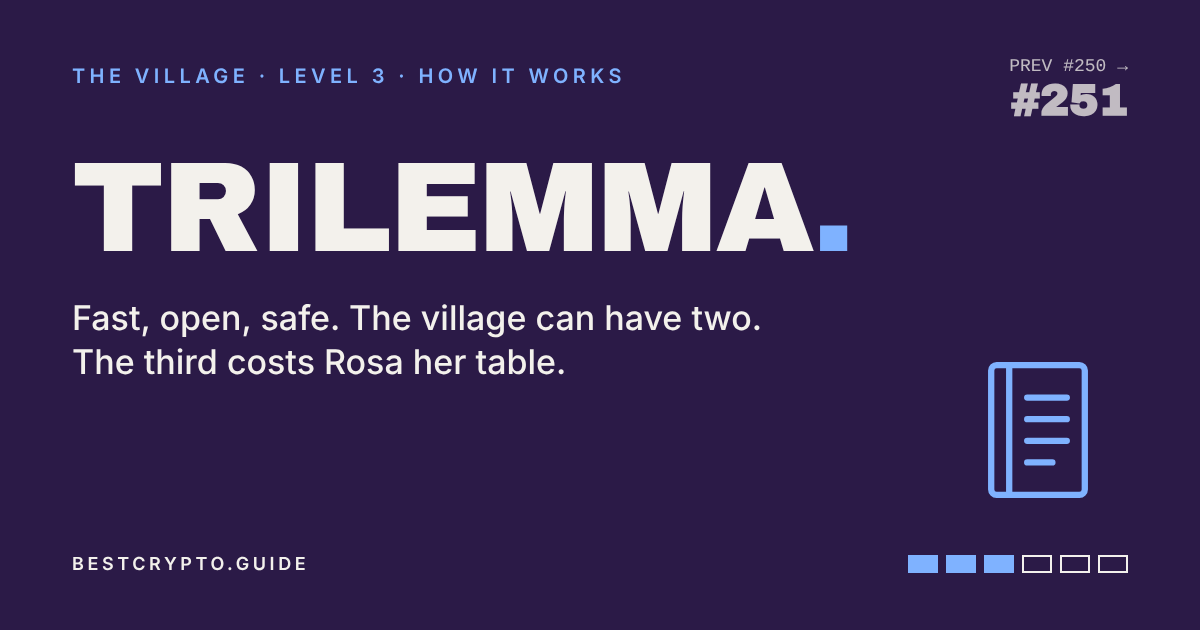
The blockchain trilemma says a chain built with simple techniques can have at most two of three things: lots of transactions, no dependence on a few big operators, and resistance to attack. Every speed record is paid for with one of the other two.
The village notebook gets a new page every ten minutes, and every house copies it. Grandma Rosa copies hers on an old kitchen table. The pages are small, so she keeps up.
The busy families want more lines per page. Fine, says the village, but then Rosa's table is too small, and only the big houses with long tables can keep a copy. Or we keep the small pages and let three big houses write the rest. Or we let anyone write fast and hope nobody cheats.
That's the blockchain trilemma. A chain can be fast, open to ordinary computers, and hard to cheat, but with simple designs it only gets two of the three. Every speed record you read about has paid for itself with one of the others.
What it is
The trilemma is an idea, not a law of physics. Vitalik Buterin, Ethereum's co-founder, set it out in his April 2021 essay on sharding (Buterin, 2021). He names three properties:
- Scalability: "the chain can process more transactions than a single regular node (think: a consumer laptop) can verify."
- Decentralization: "the chain can run without any trust dependencies on a small group of large centralized actors."
- Security: "the chain can resist a large percentage of participating nodes trying to attack it".
His claim: "if you stick to "simple" techniques, you can only get two of those three". Note the word simple. The whole scaling section of this site is about the less simple techniques.
How it works: count the lines and the tables
Throughput is lines per page times pages per hour. The cost is paid at every table that copies them.
- Bitcoin. In 15 full blocks on the evening of 18 November 2026, the network carried about 4,883 transactions per block (mempool.space). At one block per 600 seconds, that's about 8 per second. Bitcoin's own site asks a full node for "2 gigabytes of memory (RAM)" and a download of the whole chain, "roughly 740 gigabytes" (bitcoin.org).
- Ethereum. A plain ether transfer needs "a gas limit of 21,000 units of gas" (ethereum.org). On 19 November 2026, block 26,449,058 had a gas limit of 60,000,000 (Etherscan). 60,000,000 ÷ 21,000 = 2,857 transfers at most, every 12 seconds: about 238 per second, if the block held nothing but simple transfers. The price: ethereum.org's minimum for a node is "16 GB RAM" and a "4 TB NVMe SSD" (ethereum.org).
- A chain built for speed. Solana's main validator software, Agave, asks for "256GB or more" of RAM and "at least 2 GBit/s symmetric" internet (Anza).
Line them up. Roughly 8, then 238 per second at Ethereum's theoretical ceiling. Memory goes from 2 GB to 16 GB to 256 GB. Ethereum asks for 8 times Bitcoin's minimum, Solana's validators 128 times. Each step up in speed is a step up in the table you need. Some chains spend the difference on fewer, bigger tables. Others keep the tables small and accept fewer lines. Neither is cheating. It's the trade, written in hardware.
Buterin's essay puts the other way out of the triangle in plain terms: chains that lean on speed tend to rely on "a small number of nodes (often 10-100)" to keep consensus. A chain that shrinks to a handful of keepers to speed up has traded away the second property.
Why it matters
- Who gains from small pages. Anyone who wants to check the record without trusting a big house. Grandma Rosa keeps her vote because she keeps her copy.
- Who pays. Users, in fees and waiting time, whenever the pages are full.
- Who gains from big pages. Users who want cheap, fast transactions, and the operators who can afford the hardware and end up holding more of the pen.
- Why the rest of this section exists. Layer 2 systems, rollups, sharding and payment channels are all attempts to get more lines without making Rosa's table bigger.
Where people get it wrong
- "Our chain solved the trilemma." Read what it gave up. Usually it's the hardware bill for each node, or the number of nodes.
- "Transactions per second tells you which chain is best." It tells you one corner of the triangle. Ask how many independent operators check those transactions, and on what hardware.
- "Security just means not being hacked." In the trilemma, security means resisting a large share of the network's own participants turning against it.
- "Bitcoin is slow because its developers are behind." The small pages are a choice. "Why blockchains are slow on purpose" explains the sum.
Before you believe a speed claim
When a chain advertises its speed, find its node or validator requirements page and read the memory and bandwidth lines. Then ask how many independent operators run one. Two numbers, five minutes.
The fastest notebook in the world is easy to build. You just have to let one house keep it.
Frequently asked questions
What is the blockchain trilemma?
It's the idea that a blockchain using simple designs can only have two of three properties: scalability, decentralisation and security. Vitalik Buterin set it out in an April 2021 essay. Raising throughput usually means bigger hardware for each node or fewer nodes doing the checking.
Who came up with the blockchain trilemma?
The term is most closely associated with Ethereum co-founder Vitalik Buterin. His April 2021 essay "Why sharding is great" defines the three properties and says that with simple techniques you can only get two of them.
How fast is Bitcoin compared with Ethereum?
In full blocks on 18 November 2026, Bitcoin carried about 8 transactions per second. Ethereum's gas limit of 60,000,000 on 19 November 2026 fits at most about 2,857 simple transfers per 12-second block, roughly 238 per second, and fewer once transactions do more than send ether.
Has any blockchain solved the trilemma?
Not with simple designs, which is the claim itself. Projects try to get around it with techniques such as layer 2 systems, rollups and sharding, which move work off the main chain or split it up while keeping the main chain checkable by ordinary computers.
Why can't every node just use better hardware?
Because every increase in hardware requirements shuts out people who can't afford it. Bitcoin's minimum is 2 GB of RAM, Ethereum's 16 GB and Solana's main validator software asks for 256 GB. The fewer people who can run a node, the more the system depends on a small group of large operators.
Sources
- Vitalik Buterin, Why sharding is great: demystifying the technical properties (7 April 2021)
- bitcoin.org, Running a full node (minimum requirements)
- ethereum.org, Spin up your own Ethereum node (hardware requirements)
- ethereum.org, Gas and fees
- Etherscan, Ethereum block 26,449,058 (19 November 2026, gas limit)
- mempool.space API, Bitcoin blocks up to 976,485 (read on 18 November 2026)
- Anza, Agave validator requirements