How exchanges make money: the shovel seller's till has more than one drawer
Exchanges earn a cut of every trade, and small customers pay the biggest cut. They also earn on the money and coins customers leave with them: interest on stablecoin reserves, a share of staking rewards, interest on cash. The trading fee is only the drawer you can see.
There's an old line about every gold rush: the surest money wasn't in the creek. It was in the store that sold the shovels.
The store didn't care whether you found gold. It earned when you bought the shovel, when you sold your dust, and when you left your bag in its safe overnight.
Crypto exchanges work the same way. The trading fee is the drawer you see. The till has several more.
What it is
An exchange earns in two broad ways. First, from activity: a fee or a spread every time a customer buys, sells or swaps, plus fees for some deposits and withdrawals. Second, from balances: whatever it can earn on the money and coins customers leave with it, such as interest on cash, interest on the reserves behind stablecoins, and a share of staking rewards.
The first drawer fills when markets are busy. The second fills when customers sit still. A shop with both earns in good weeks and quiet ones.
How it works: one shop's till, opened
Most exchanges don't publish their accounts. One that does is Coinbase, a US company listed on the stock market. We use its figures because they are audited and public, not as a recommendation.
For 2025, Coinbase reported net revenue of $6,883.4 million (Coinbase, 2026). Here is where it came from:
- Transaction revenue: $4,055.4 million, about 59% of the total. Of that, $3,322.8 million came from consumers and $479.7 million from institutions.
- Subscription and services: $2,828.0 million, about 41%. The biggest part was "stablecoin revenue" of $1,348.8 million. Then "blockchain rewards" from staking, $677.4 million, and interest and finance fee income, $247.0 million.
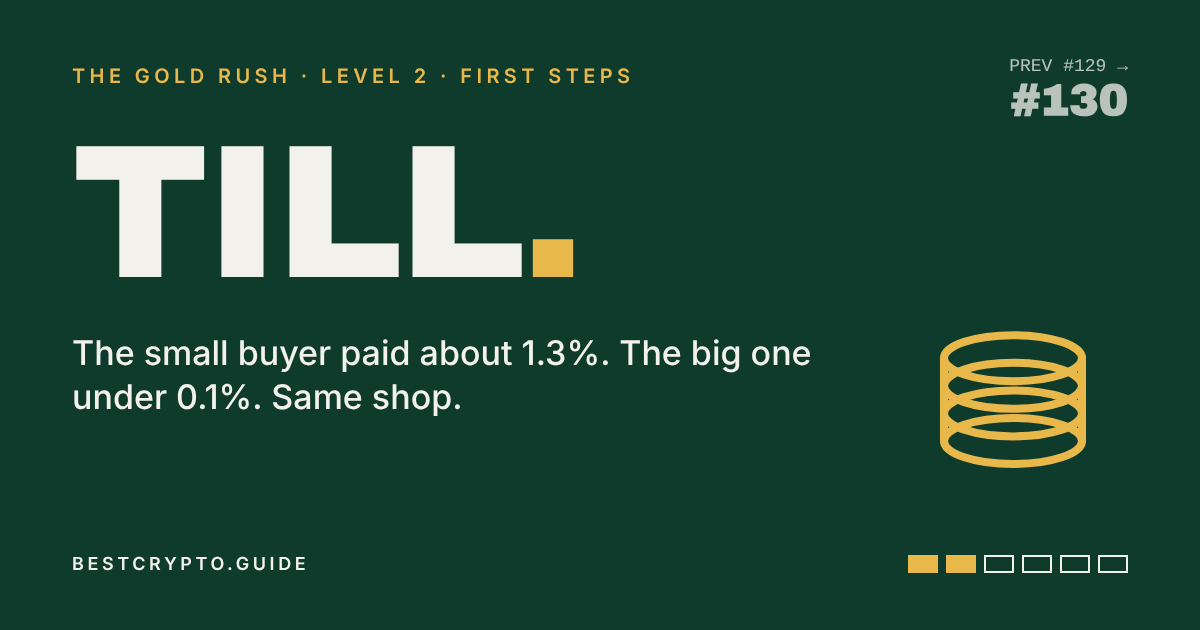
Now the part the fee page doesn't show. In the last quarter of 2025, Coinbase earned $733.9 million in consumer transaction revenue on about $56 billion of consumer trading. Institutions brought in $185.0 million on about $215 billion of trading (same letter). Our arithmetic: consumers paid roughly 1.3% of what they traded. Institutions paid under 0.1%. The figures are rounded and include more than the listed fee, so treat them as rough. The gap is not.
Institutions traded about four times as much and paid about a quarter as much.
The second drawer is in the same letter. The company ties its stablecoin revenue to the dollar stablecoin USDC held in its products, on average $17.8 billion in that quarter, and to "lower effective interest rates on reserves" after rate cuts in October and December 2025. The money behind a stablecoin sits in safe assets that pay interest, and a share of that interest ends up in the shop's till. Whether any of it reaches the customer depends on the shop's terms.
Why it matters
The price list says the same thing from the shop's side. On fee pages read on 19 November 2026 (examples, not recommendations):
- Bitvavo charges 0.15% for makers and 0.25% for takers in euro markets at its lowest tier (Bitvavo), and recalculates your tier from your 30-day trading volume (Bitvavo help).
- Kraken Pro charges 0.40% for makers and 0.80% for takers at its first tier, for $0 and up of 30-day volume (Kraken).
Both rates fall as your volume rises. That's normal pricing for any wholesale shop, and it means the small, occasional buyer pays the most per euro. Simple "buy" buttons usually cost more than the order-book screen; our articles on broker apps vs exchanges and on the spread show by how much.
Who gains from the second drawer? The shop, every time you leave a balance idle. Who pays? Nobody sees a bill, which is exactly why it's a good business.
In the EU, MiCA requires licensed firms to publish "their policies on pricing, costs and fees" in "a prominent place on their website", and to act "honestly, fairly and professionally in accordance with the best interests of their clients" (EUR-Lex; readable version in ESMA's single rulebook). Published, yes. Small, also yes.
Where people get it wrong
- "The exchange earns from fees, that's all." At Coinbase in 2025, about 41% of net revenue came from subscriptions and services, much of it from balances, not trades.
- "Zero commission means free." Then the money is in the spread, or in what the shop earns on your idle balance.
- "Everyone pays the same rate." Rates fall with volume. The beginner buying €50 a month is the shop's best customer per euro.
- "Busy markets are good for me." They're good for the till. Every extra trade is another fee, whatever happens to your coins.
Find your own rate
Download your exchange's account statement for the past twelve months. Add up every fee you paid, and every spread if the statement shows it. Divide by the total amount you traded.
That's your real rate. Compare it with the fee page, then with the 0.1% the big traders pay.
The shovel seller never needed to find gold. He only needed you to keep digging.
Frequently asked questions
How do crypto exchanges make money?
Mainly from trading fees and spreads on each purchase, sale or swap. Many also earn from customers' balances: interest on cash and on the reserves behind stablecoins, and a share of staking rewards. Some charge for deposits, withdrawals or subscriptions.
Why do small traders pay higher fees than large ones?
Exchanges set fee tiers by trading volume, usually over the past 30 days, and the rate falls as volume rises. In Coinbase's figures for the last quarter of 2025, consumers paid roughly 1.3% of what they traded, while institutions paid under 0.1%. That arithmetic is approximate but the gap is large.
Do exchanges earn money from stablecoins I hold with them?
They can. The reserves behind a dollar stablecoin are held in interest-paying assets, and some exchanges receive part of that interest. Coinbase reported $1,348.8 million of stablecoin revenue in 2025 and linked it to the stablecoin balances held in its products and to interest rates.
Is a zero-fee crypto app really free?
No. If there's no visible fee, the firm usually earns through the spread between the buy and sell price, or through what it earns on customers' balances. Compare what you pay with what you'd get selling straight back.
Are exchanges required to publish their fees in the EU?
Yes. Under MiCA, licensed crypto-asset service providers must publish their policies on pricing, costs and fees in a prominent place on their website. Trading platforms must also have fee structures that are transparent, fair and non-discriminatory.
Sources
- Coinbase Global, Form 8-K with Fourth Quarter and Full Year 2025 Shareholder Letter (12 February 2026)
- Bitvavo, Fees (example, read on 19 November 2026)
- Bitvavo, What is the trading fee when I buy or sell crypto? (example, read on 19 November 2026)
- Kraken, Kraken Pro fees (example, read on 19 November 2026)
- EUR-Lex, Regulation (EU) 2023/1114 on markets in crypto-assets (MiCA)
- ESMA, Interactive single rulebook: MiCA Article 66, Obligation to act honestly, fairly and professionally in the best interest of clients