Derivation paths: your coins didn't disappear, the app took another road
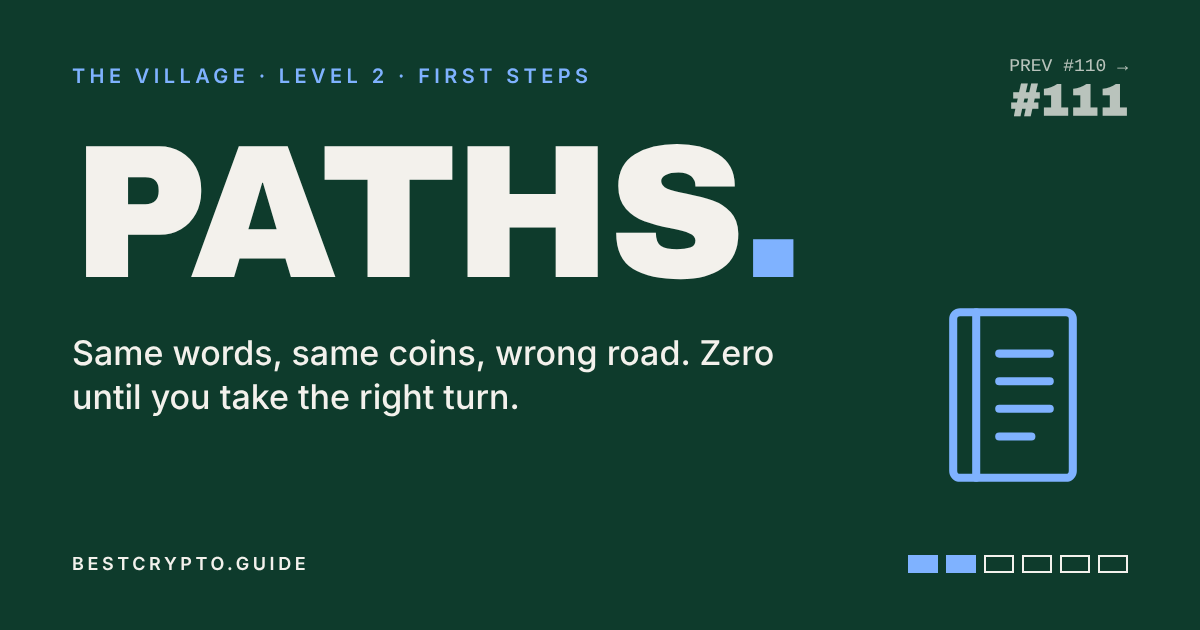
The same recovery words can lead to many different addresses, depending on the derivation path the wallet follows. If a restored wallet shows zero, the coins are almost always still there, on a road the new app isn't checking.
Grandma Rosa's old phone dies, so she buys a new one. She installs a different wallet app, types in her twelve words carefully, and the screen says: balance 0. She sits down. Her savings are gone.
They aren't. Every house in the village still has the same notebook, and Rosa's coins sit on the same page they always did. Her words are right too. The new app simply walked down a different lane of the village and knocked on doors where she never lived.
That lane is called a derivation path. Same words, different road, different addresses. Pick the right road and the coins come back on screen, because they never left.
What it is
Your recovery words don't make one key. Through a standard called BIP 32, they grow a whole tree of keys, branch by branch (BIP 32). A derivation path is the address of one leaf on that tree, written like m/84'/0'/0'/0/0.
BIP 44 fixed the meaning of each step: "m / purpose' / coin_type' / account' / change / address_index" (BIP 44). The first number after m, the purpose, says which recipe the wallet uses. Two wallets with the same words but different recipes will show different addresses, and each will only look for coins at its own.
How it works: one phrase, four Bitcoin addresses
Take the public test phrase developers use: "abandon" eleven times, then "about". Never put money on it. Everyone in the world knows these words.
Here is the first receiving address for Bitcoin account 0 under four common recipes:
- Purpose 44, the original. Path m/44'/0'/0'/0/0 gives 1LqBGSKuX5yYUonjxT5qGfpUsXKYYWeabA. Old-style addresses start with 1.
- Purpose 49, SegWit wrapped for older wallets. Path m/49'/0'/0'/0/0 gives 37VucYSaXLCAsxYyAPfbSi9eh4iEcbShgf, starting with 3 (BIP 49).
- Purpose 84, native SegWit. Path m/84'/0'/0'/0/0 gives bc1qcr8te4kr609gcawutmrza0j4xv80jy8z306fyu, the official test vector (BIP 84).
- Purpose 86, Taproot. Path m/86'/0'/0'/0/0 gives bc1p5cyxnuxmeuwuvkwfem96lqzszd02n6xdcjrs20cac6yqjjwudpxqkedrcr, again the official test vector (BIP 86).
The 84 and 86 addresses come straight from the standards. We derived the 44 and 49 addresses ourselves with an open-source library that reproduces those test vectors and the testnet vector published in BIP 49.
Four addresses, four separate lines in the notebook, one set of words. If Rosa's coins sit at the purpose-84 address and her new app only checks purpose 44, the app honestly reports zero. It's looking at the wrong door.
Other roads to an empty screen
The recipe is the most common cause, but not the only one.
- The wrong account. Many wallets let you open account 1, 2 and so on. A restore that checks only account 0 misses the rest.
- The gap limit. BIP 44 tells wallets to stop scanning after 20 unused addresses in a row, assuming nothing lies beyond. A wallet that handed out many addresses that were never paid can hide coins past that point.
- A different word system. Electrum, a long-running Bitcoin wallet, uses its own seed format with a version number built in. Its documentation says plainly that "Electrum does not generate BIP39 seeds" (Electrum). Same word list, different maths.
- A passphrase. As our article on the 25th word explains, the words plus a different passphrase open a different, valid, empty wallet.
- A different coin. The second number in the path is the coin. Bitcoin is 0. Restoring the right words in an app for another chain will never show your bitcoin.
Why it matters
The good news is big. The words really are portable, which is why our Wallets section could say your coins survive a wallet company going out of business. The bad news is that "portable" comes with a missing manual. BIP 39 phrases carry no label saying which road to take, and Electrum's documentation names that as a weakness: the words "do not include a version number", so software must already know how to generate the keys and addresses.
Panic is where the real damage happens. An empty screen pushes people to type their words into "recovery" sites, or to trust a stranger who offers to find the coins for a fee. Both are worse than the original problem.
Where people get it wrong
- "Zero balance means I was hacked." Possible, but check the road first. A block explorer can show whether the old address still holds coins without your words.
- "My words are wrong." If the app accepted them, the checksum passed. Wrong recipe is far more likely than wrong words.
- "Paths are a secret like the words." They're not. Knowing m/84'/0'/0' gives a thief nothing without the words.
- "Any app will find my coins." Only if it follows the same recipe, account and passphrase. Many apps let you choose the path or script type in advanced settings.
Write down the road
Next to your recovery words, or in a separate note, write three harmless facts: which wallet app made them, the address type (starting with 1, 3, bc1q or bc1p), and whether you used a passphrase. Not the passphrase itself, just the fact.
Those three lines turn a frightening afternoon into a two-minute fix. The coins were never lost. Rosa just needed to know which lane she lives on.
Frequently asked questions
Why does my restored wallet show a zero balance?
Usually because the new app follows a different derivation path, account or address type than the old one. The coins are still at the old addresses. Change the path or address type in the app's settings, or restore in an app that supports the original one.
What is a derivation path in crypto?
It's the route a wallet follows from your recovery words to one particular key and address, written like m/84'/0'/0'/0/0. The numbers say which standard, which coin, which account and which address. Different paths from the same words give completely different addresses.
What is the difference between BIP 44, 49, 84 and 86?
They are recipes for Bitcoin address types. BIP 44 gives old-style addresses starting with 1, BIP 49 gives wrapped SegWit addresses starting with 3, BIP 84 gives native SegWit addresses starting with bc1q, and BIP 86 gives Taproot addresses starting with bc1p.
Can I restore an Electrum seed in another wallet?
Only in a wallet that supports Electrum's own seed format. Electrum seeds are not BIP 39 phrases, even though they use the same word list, so a standard BIP 39 wallet will produce the wrong addresses.
Is it safe to write down my derivation path?
Yes. A derivation path or address type is not secret and gives nobody access without the recovery words. Writing it down makes a future restore much easier.
Sources
- BIP 32, Hierarchical deterministic wallets (Pieter Wuille)
- BIP 44, Multi-account hierarchy for deterministic wallets (Palatinus, Rusnak)
- BIP 49, Derivation scheme for P2WPKH-nested-in-P2SH based accounts (Weigl)
- BIP 84, Derivation scheme for P2WPKH based accounts (Rusnak)
- BIP 86, Key derivation for single key P2TR outputs (Chow)
- Electrum documentation, Electrum seed version system (spesmilo/electrum-docs on GitHub)