Arbitrage explained: the free money between two price boards, minus fees, time and locked doors
Arbitrage means buying where something is cheap and selling where it is dear at the same moment. Crypto prices do differ between exchanges, but fees, transfer times and capital controls usually eat the gap before an ordinary trader can.
Imagine two trading posts in two valleys. In one, the clerk pays 100 for a bag of dust. In the other, 105. Picture a prospector with a fast mule: buy here, ride over, sell there, pocket five.
The trick only works if the mule is fast, the road is open and nobody at the gate charges a toll. Usually one of the three fails.
That's arbitrage. In theory it's the closest thing markets have to free money. In practice, most of the gap belongs to whoever owns the fastest mule, and the shovel sellers charge for the road.
What it is
Arbitrage is buying something in one market and selling it in another at the same time, to profit from a price difference. It's not a bet on the price going up or down. It's a bet that two prices for the same thing will come back together.
Arbitrage is also what keeps prices close in the first place. Every time someone closes a gap, they push the cheap price up and the dear price down. That's why bitcoin trades at nearly the same price on large exchanges in the same country.
How it works
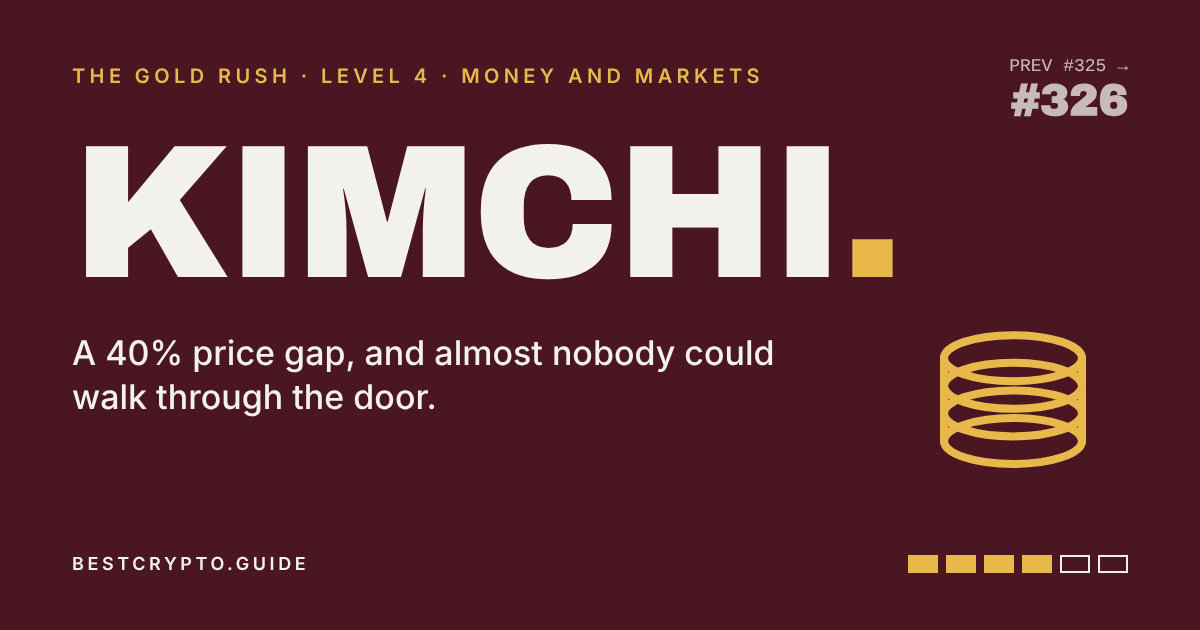
The famous case: the "kimchi premium". The economists Igor Makarov (LSE) and Antoinette Schoar (MIT Sloan) studied trade-level data from 34 exchanges in 19 countries. They found that "the daily average price ratio between the US and Korea from December 2017 until the beginning of February 2018" "was more than 15% and reached 40% for several days" (Makarov and Schoar, 2019).
They estimated "a minimum of $2 billion of potential total arbitrage profit" from December 2017 to February 2018. Meanwhile, price gaps between exchanges in the same country "typically do not exceed 1%, on average" (Harvard Law School Forum, 2019).
So why did the money stay on the table? The authors point to capital controls: their findings "suggest that such controls contribute to the large arbitrage spreads". Arbitrage needs money to flow both ways: coins in one direction, cash back in the other. Capital controls lock one of those doors.
The everyday case. A worked example with assumed numbers. Exchange A sells bitcoin at the house figure, $63,154.72 (CoinGecko, 18 November 2026). Exchange B shows a bid of $63,400.
- The gap. $63,400 minus $63,154.72 is $245.28, or 0.39%. Looks good.
- The fees. Assume a 0.1% taker fee on each side. Buying costs $63.15, selling costs $63.40. Together: $126.55. What's left: $118.73.
- The road. The coin has to move from A to B. Read on 19 November 2026, Kraken lists bitcoin deposits at "3 Confirmations" and an estimated "45 Minutes" (Kraken). Coinbase lists 2 confirmations (Coinbase). These are examples, not recommendations. Add the withdrawal fee and the time before A releases the coin.
- The risk. If B's price slips by 0.19% while your coin is on the road, that's about $120, and the whole $118.73 is gone.
Professionals get round the road by keeping money and coins on both exchanges in advance, buying on one and selling on the other in the same second. That takes capital, fast software and low fee tiers. The prospector on the mule has none of them.
The futures case. A third kind uses "Futures explained": buy bitcoin and sell a futures contract at the same time. CME's contract is cash-settled against a reference rate on expiry (CME Group), so the basis between the two shrinks to zero by then. If the basis is wide enough to beat the costs, that gap is the target. It's slower, safer and smaller than the saloon makes it sound.
Why it matters
- It keeps one price for one coin. Without arbitrage, "the price of bitcoin" would mean much less.
- The gap tells you something. A big, lasting premium usually means money can't move freely: capital controls, frozen withdrawals or a struggling exchange.
- The shovel sellers win the small gaps. Fees go to the exchanges on both sides, every time, whether the trade made money or not.
Where people get it wrong
- "Risk-free profit." The moment your coin is on the road, you're exposed to the price.
- "I saw a 5% gap on a tracking site." Often it's a thin market, a stale price or an exchange where withdrawals are stuck. That's not a gap, it's a warning.
- "Arbitrage bots for sale will do it for me." If a bot reliably found free money, its owner wouldn't need to sell it to you.
- "The kimchi premium proves easy money exists." The study's point is the opposite: the money stayed on the table because almost nobody could take it.
Ask why the gap is still there
When someone shows you a price gap between two exchanges, ask one question: if this is free money, why hasn't someone faster already taken it? There's always an answer. It's usually fees, time, or a door you can't open.
In 2018, a 40% gap sat open for days because the door was locked. A 0.4% gap on your phone usually stays open because the toll eats it.
Frequently asked questions
What is crypto arbitrage?
It is buying a coin where it is cheaper and selling it where it is dearer at the same time, to profit from the price difference. It doesn't depend on the price rising or falling, only on the gap closing.
What was the kimchi premium?
It was the higher price of bitcoin on South Korean exchanges compared with the US. According to Makarov and Schoar, the daily average gap was more than 15% from December 2017 to early February 2018 and reached 40% for several days.
Why didn't traders close the kimchi premium?
Makarov and Schoar link it mainly to capital controls, which limit how freely money moves in and out of a country. Arbitrage needs money to flow both ways, so the gap stayed open.
Is crypto arbitrage risk-free?
No. Transfers between exchanges take time, often tens of minutes for bitcoin, and prices can move while the coin is in transit. Trading and withdrawal fees on both sides also eat into the gap.
Why are prices different on different exchanges?
Each exchange has its own order book, buyers and sellers. Within one country, arbitrage usually keeps large exchanges within about 1% of each other. Across borders, capital controls and banking limits can let bigger gaps persist.
Sources
- Igor Makarov and Antoinette Schoar, Trading and arbitrage in cryptocurrency markets (preprint, 20 March 2019)
- Harvard Law School Forum on Corporate Governance, Makarov and Schoar, Trading and arbitrage in cryptocurrency markets (21 September 2019)
- Kraken, Cryptocurrency deposit processing times (support article)
- Coinbase, Confirmations (help centre glossary)
- CME Group, What are bitcoin futures? (education course)