Bull and bear markets: the 20% rule from shares, and bitcoin's 84% reality
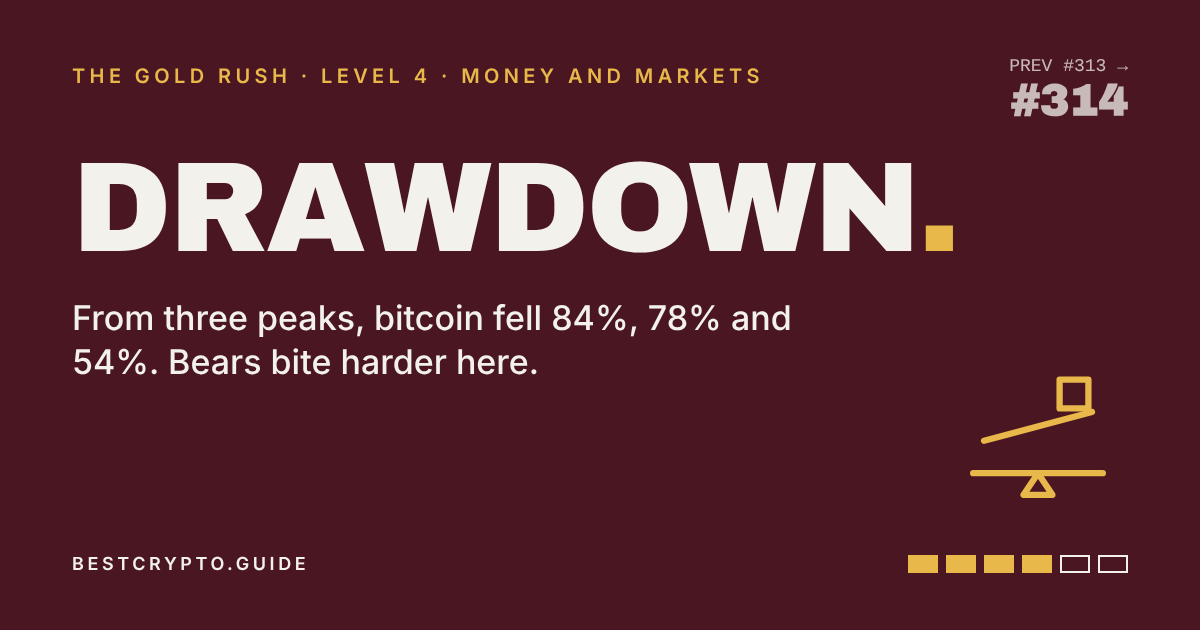
A bull market is a long rise, a bear market a long fall. In shares, the usual rule of thumb is a move of 20% or more over at least two months. Bitcoin has fallen far more than that from every peak: 84%, 78% and 54% from its last three.
Picture the saloon after a good week at the diggings. Every table has a story about a nugget. Newcomers arrive daily, and the price of dust at the trading post climbs with every wagon.
Then the wagons start leaving. Nuggets get rarer, the stories get shorter, and the price falls week after week. The same men who said "it only goes up" now say "it's finished".
Markets call the first mood a bull market and the second a bear market. In shares, there's a rule of thumb for when one becomes the other. In crypto, the rule gets broken so often it's barely a rule.
What it is
A bull market is a long period of rising prices and optimism. A bear market is a long period of falling prices and gloom. The usual picture: a bull tosses its horns upwards, a bear swipes its paws down.
The US regulator's investor website gives the common yardstick for shares. A bull market "generally" occurs "when there is a rise of 20% or more in a broad market index over at least a two-month period". A bear market "generally" occurs "when a broad market index falls by 20% or more over at least a two-month period" (Investor.gov, bull market; bear market).
Note the word "generally". It's a convention, not a law. Nobody rings a bell when one starts.
The fall from a peak to a later low has its own name: a drawdown.
How it works
Take bitcoin's last three big peaks, measured on one market, Coinbase's BTC-USD order book. The figures are the highest daily high and the lowest daily low that followed, from Coinbase's public daily candles, read on 19 November 2026.
Peak 1. High of 19,891.99 dollars on 17 December 2017 (Coinbase). Low of 3,128.89 dollars on 15 December 2018 (Coinbase). The drawdown: 1 minus 3,128.89 divided by 19,891.99, which is 84.3%, over 363 days.
Peak 2. High of 69,000 dollars on 10 November 2021 (Coinbase). Low of 15,460 dollars on 21 November 2022 (Coinbase). The drawdown: 77.6%, over 376 days.
Peak 3. High of 126,296 dollars on 6 October 2025 (Coinbase). The lowest daily low between then and 18 November 2026 was 57,717.55 dollars on 1 July 2026 (Coinbase). The drawdown so measured: 54.3%. Whether that low holds is not something anyone can know.
Now the 20% yardstick. After the October 2025 peak, Coinbase's daily low on 21 November 2025 was 80,524.65 dollars. That's 36.2% below the peak, after 46 days. By the stock-market rule, it didn't even qualify yet: the definition wants two months. The bear had to wait in the corridor for a fortnight before the textbook let it in.
The rises in between were just as extreme. From the December 2018 low to the November 2021 high, the price multiplied about 22 times. From the November 2022 low to the October 2025 high, about 8 times. Each of those rises ended in a fall of more than half.
Why it matters
The maths of the climb back. A fall of 84.3% leaves 15.7% of the starting value. To get back to the peak, the price has to multiply by about 6.4, a rise of more than 530%. A 54.3% fall needs a rise of about 119%. Losses and gains aren't symmetrical, and the deeper the hole, the longer the ladder.
Who gains from the labels. The saloon loves them. "We're in a bull market" sells courses and signal groups. "This is the bottom" sells them too. Both are opinions dressed as facts, because the start and end of a bull or bear market are only visible afterwards.
Who pays. People who buy at the top because everybody is talking about it, and people who sell at the bottom because everybody has stopped. The shovel seller takes a fee both times.
Where people get it wrong
- "A 20% fall means it's a bargain." In each of the three drawdowns above, the price was down 20% long before it reached the bottom. The label says nothing about the next move.
- "The bear market is over because the price rose for a week." Bear markets have sharp rises inside them. Only hindsight names the bottom.
- "Bitcoin always comes back." It climbed from its 2018 and 2022 lows to new highs. That's history, not a promise, and many smaller coins never climbed back at all.
- "Bull and bear are official terms." They're conventions. Different sources draw the lines differently.
Know your drawdown before the bear does
Before you buy, take the amount you plan to put in and multiply it by 0.16. That's roughly what was left of a purchase at the December 2017 peak by December 2018. Multiply by 0.22 for the 2021 to 2022 fall. Could you live with that number for a year or more?
If not, buy less. The bear doesn't check the calendar, and it doesn't read the saloon's newsletter.
Frequently asked questions
What is a bull market?
A bull market is a long period of rising prices and optimism. For shares, the US SEC's investor website says it generally means a rise of 20% or more in a broad market index over at least two months. In crypto the term is used more loosely.
What is a bear market?
A bear market is a long period of falling prices and pessimism. The common yardstick for shares is a fall of 20% or more in a broad market index over at least two months. Bitcoin's falls from its peaks have been much larger: 84.3% after December 2017 and 77.6% after November 2021, measured on Coinbase.
What is a drawdown?
A drawdown is the fall from a peak to a later low, usually given as a percentage. Measured on Coinbase's BTC-USD market, bitcoin's drawdown from its 6 October 2025 high of 126,296 dollars to its 1 July 2026 low of 57,717.55 dollars was 54.3%.
How do you know when a bear market has ended?
Only afterwards. A bottom is clear once the price has risen well above it and stayed there, which nobody can see in advance. Sharp rises inside a bear market are common and often fade.
Why does a big fall need an even bigger rise to recover?
Because the rise starts from a smaller number. After a 50% fall, the price must double, a 100% rise, to get back. After an 84% fall, it must multiply by more than six.
Sources
- Investor.gov (US Securities and Exchange Commission), Glossary: bull market
- Investor.gov (US Securities and Exchange Commission), Glossary: bear market
- Coinbase Exchange, BTC-USD daily candles, December 2017 (public API, read on 19 November 2026)
- Coinbase Exchange, BTC-USD daily candles, 15 November 2018 to 31 January 2019 (public API, read on 19 November 2026)
- Coinbase Exchange, BTC-USD daily candles, November 2021 (public API, read on 19 November 2026)
- Coinbase Exchange, BTC-USD daily candles, November to December 2022 (public API, read on 19 November 2026)
- Coinbase Exchange, BTC-USD daily candles, 6 October 2025 to 1 February 2026 (public API, read on 19 November 2026)
- Coinbase Exchange, BTC-USD daily candles, February to April 2026 (public API, read on 19 November 2026)
- Coinbase Exchange, BTC-USD daily candles, May to 19 November 2026 (public API, read on 19 November 2026)