Inflation explained: the tax nobody voted for
Inflation is the rise in prices over time, which means each euro buys a little less. A little is the plan. A lot is a crisis, and it hits savers and people on fixed incomes first.
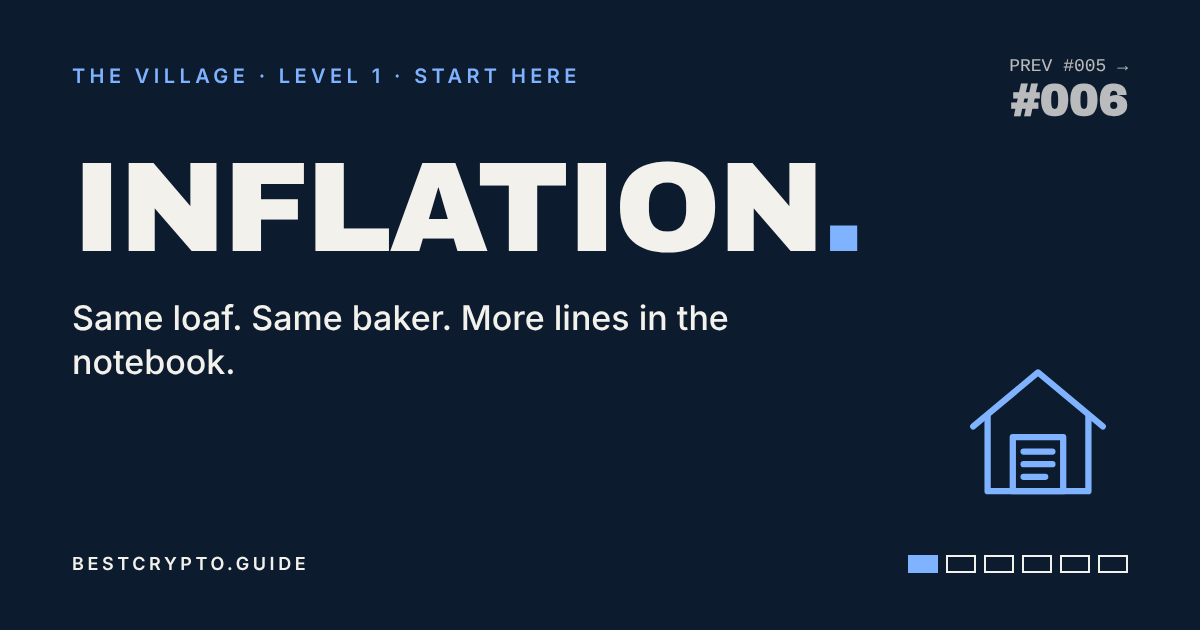
Anna bakes the same loaf every morning. Same flour, same oven, same baker. For years it cost one coin.
Then the notebook keeper starts writing more lines than the village has bread. Everyone has more coins on paper. Everyone wants bread. Anna's shelf is the same size. So she charges two coins, and still sells out by noon.
Nobody stole anything from Grandma Rosa. Her notebook line still says twenty coins. It just buys ten loaves instead of twenty. That's inflation: not a robbery, a quiet shrinking.
What it is
Inflation is the rate at which prices rise across the economy. Turn it around and it's the rate at which your money loses buying power.
In the euro area it's measured by the harmonised index of consumer prices, the HICP. Eurostat tracks a fixed basket of what households buy and compares its price with the same month a year earlier. The ECB aims for 2% a year over the medium term (ECB, 2025). Not zero. A little, on purpose.
How it works
Take Eurostat's figures for October 2026 (Eurostat, 2026).
- Euro area inflation was 4.0%, up from 3.8% in September and 2.1% a year earlier. A basket that cost €100 in October 2025 cost €104 in October 2026.
- Not everything rose equally. Energy was up 21.0%. A €100 energy bill became €121. Services rose 3.3%, food, alcohol and tobacco 1.5%.
- The basket has weights. Services make up about 47% of it, energy about 9%. Energy is small in the basket and still added 1.89 percentage points of the 4.0%, the biggest single contribution.
- Countries differ. Romania had 7.0%, Sweden 0.6%. In the euro area, Germany had 2.9% and Italy 5.6%.
That last point matters for you. The headline figure is an average. Your personal inflation depends on what you buy. If you heat with gas and drive to work, October 2026 felt a lot worse than 4%.
Now the long view. At the ECB's 2% target, prices roughly double in 35 years. A pensioner who saved €50,000 in cash at 30 finds it buys about half as much at 65. That's the plan working as designed.
When it goes wrong
Inflation doesn't always stay polite.
In October 2022, euro area inflation hit 10.6%, driven mostly by energy (Eurostat, 2022). Prices that had crept for years suddenly ran.
And then there's the extreme case. In Germany, a loaf of bread cost 0.80 marks in December 1919. By January 1923 it cost 250 marks. In November 1923 it cost 201 billion marks, and one US dollar bought 4.2 trillion marks (Deutscher Bundestag). The government ended it by introducing a new currency from 15 November 1923, swapping one trillion old marks for one new one.
That's hyperinflation: the keeper writing lines so fast the notebook stops meaning anything.
Why it matters
- Savers lose. Money in a current account at 0% loses value every year inflation is above zero.
- Borrowers gain. A fixed debt gets lighter as prices and wages rise. Governments are among the biggest borrowers.
- The poorest pay most. Energy and food take a larger share of small budgets, and those are often what jumps first.
- It's why Bitcoin exists. Bitcoin was designed with a fixed supply. Nobody can write extra lines. That doesn't make its price stable, as anyone who held it through a crash knows. It makes its supply predictable. Different thing.
Where people get it wrong
- "Inflation means everything costs more." It's an average. Some prices rise much faster, some fall.
- "Low inflation means prices are falling." No. 2% inflation means prices still rise, just slowly.
- "Inflation is 4%, so my costs went up 4%." Your basket isn't the official basket. Yours may be higher or lower.
- "Bitcoin protects you from inflation." Bitcoin's supply is fixed; its price isn't. A hedge whose price can fall sharply in weeks isn't a savings account.
Check your own inflation
Pick five things you buy every month: rent, electricity, a weekly shop, fuel, your phone. Write down what each costs, and what it cost twelve months earlier. Add them up.
That's your inflation. It's often different from the headline. And it's a better number to hold in your head than any promise from a stranger at the gate that his coin "beats inflation".
Frequently asked questions
What is inflation?
Inflation is the general rise in prices over time, which reduces what each unit of money can buy. In the euro area, Eurostat measures it with the harmonised index of consumer prices (HICP).
What is the euro area inflation rate?
Eurostat put euro area annual inflation at 4.0% in October 2026, up from 3.8% in September 2026 and 2.1% in October 2025. Energy prices rose 21.0% over the same year.
Why does the ECB want 2% inflation and not zero?
A small, steady rise gives a buffer against falling prices, which can freeze spending and make debts heavier. The ECB treats its 2% target as symmetric: too low is as unwelcome as too high.
What is hyperinflation?
Inflation so fast that money stops working. In Germany in November 1923, a loaf of bread cost 201 billion marks and a US dollar bought 4.2 trillion marks.
Is bitcoin a hedge against inflation?
Bitcoin's supply is fixed by its software, so nobody can create more of it at will. Its price, though, can move sharply in both directions. A fixed supply isn't the same as a stable value.