Where the picture actually lives: follow the address on the deed, and see who keeps the plot
Most NFTs store only an address on the blockchain. The description and the image sit on a company server, on IPFS or on Arweave, and only a few projects put the art itself on-chain. Where it sits decides who has to keep paying for it to stay visible.
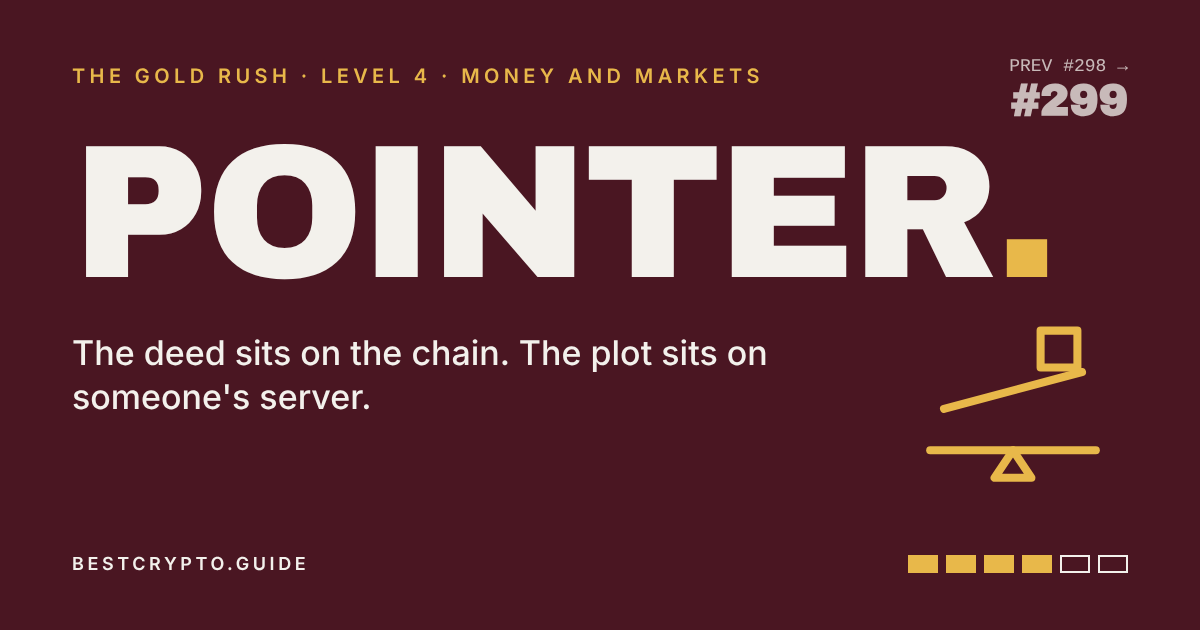
The deed in the boomtown registry says "plot 1, Cool Cat Creek". The registry keeps the deed safe. It does not keep the creek.
To see your plot, you walk to the address on the deed. Someone has to keep that road open and that land where it was. If the land company closes its office, the deed is still perfect. It just points at a locked gate.
Most NFTs work like that. The chain holds a number and an address. The picture lives wherever the address leads, and someone has to pay to keep it there.
What it is
ERC-721, the main NFT standard, has an optional function called tokenURI. It returns "A distinct Uniform Resource Identifier (URI) for a given asset": an address. That address leads to a small metadata file with a name, a description and an "image" field, which is itself "A URI pointing to a resource" (ERC-721).
So there are usually three hops: the contract, the metadata file, the image. Each hop can live in a different place. Copyright questions are a separate matter, covered in "NFTs are just JPEGs".
How it works
Follow one deed. Cool Cats is an Ethereum collection whose contract was deployed in 2021. Its verified contract on Etherscan shows a base address set at deployment: https://api.coolcatsnft.com/cat/ (Etherscan, CoolCats).
Step 1: ask the chain. Read from the Ethereum blockchain on 19 November 2026, tokenURI for token 1 returned https://api.coolcatsnft.com/cat/1. That is a web address on the company's own server.
Step 2: open the metadata. That address returned a file naming "Cool Cat #1", with traits such as "hat black" and "winter red", and an image field pointing to https://ipfs.io/ipfs/QmYrxAviWHGugdikgU1Awc8MRtfqxMYYRmBuCTMEc5mCAx (Cool Cats API). The same file also lists a copy on Google Drive.
Step 3: open the image. The image sits on IPFS, reached through the ipfs.io gateway.
Count the landlords: Ethereum for the deed, Cool Cats' server for the description, IPFS nodes and a gateway for the picture, Google for a backup. The contract's published interface also includes a setBaseURI function, so the address in step 1 is not carved in stone.
Other deeds point elsewhere. The same reading on 19 November 2026 gave:
- Doodles #1:
ipfs://QmPMc4tc.../1. Straight to IPFS, no company server in between (Etherscan, Doodles). - CloneX #1: an
arweave.netaddress (Etherscan, CloneX). - Noun 1884: not an address at all, but the whole file packed into the answer:
data:application/json;base64,..., 16,653 characters, with the picture inside as an SVG drawing (Etherscan, Nouns). That is on-chain art: no server to close.
Why it matters
Each place has a different landlord and a different bill.
- A company server works while the company pays for hosting and keeps the domain.
- IPFS finds files by their content, so the address can't be quietly swapped for another picture. But storage isn't automatic: "IPFS uses garbage collection to free disk space on your IPFS node by deleting data that it thinks is no longer needed." Files stay if someone pins them (IPFS Docs).
- Arweave asks uploaders for "an upfront contribution" to a storage endowment, priced to cover 200 years of replicated storage at the storage prices of the day (Arweave Docs). A design, paid once, not a guarantee.
- On-chain costs the most gas to write and lasts as long as the chain.
This is not theory. Nike announced in December 2024 that it was shutting down its NFT studio RTFKT. On 24 April 2025, the CloneX images stopped displaying and showed a Cloudflare notice instead. RTFKT's head of technology, Samuel Cardillo, said a Cloudflare contract had ended early; the images began coming back, and he said he was moving the collections to Arweave (via Decrypt, 24 April 2025). The CloneX address read on 19 November 2026 points to Arweave.
The deeds never changed hands. The road to the plot was simply closed for a day.
Where people get it wrong
- "It's on the blockchain, so it's permanent." Usually only the address is.
- "IPFS means stored forever." IPFS means addressed by content. Someone still has to keep a copy.
- "The picture can't change." On a company server, whoever runs the server can swap the file behind the same address.
- "The project will always maintain it." Companies close. RTFKT did.
Read the tokenURI yourself
Before buying, look up the token's tokenURI on a block explorer or in the project's docs. Note where it starts: https:// means a company server, ipfs:// means IPFS, ar:// or arweave.net means Arweave, data: means on-chain. Then check whether the owner can change that address.
You are not buying the plot. You are buying a deed and a set of directions, so read the directions.
Frequently asked questions
Where is the image of an NFT stored?
Usually not on the blockchain. The token stores a tokenURI, an address that leads to a metadata file, which in turn links to the image on a web server, IPFS or Arweave. Only some collections store the image itself on-chain.
What is a tokenURI?
A tokenURI is the address an ERC-721 contract returns for a token ID. It points to the token's metadata, usually a JSON file with a name, description and image link. It can be a web address, an IPFS or Arweave address, or the data itself.
Can an NFT image disappear?
Yes, if the place that stores it stops serving it. In April 2025, RTFKT's CloneX images briefly stopped displaying after a hosting problem with Cloudflare, according to Decrypt. The tokens themselves were unaffected.
Is IPFS permanent storage?
No. IPFS identifies files by their content, but nodes delete data they no longer need unless it is pinned. A file stays available only while at least one node keeps a copy.
What does fully on-chain NFT mean?
It means the metadata and the artwork are stored in the blockchain itself, often as code or an SVG drawing, rather than on an outside server. Nouns, for example, returns its full metadata and image directly from the contract.
Sources
- Ethereum Improvement Proposals, ERC-721: Non-Fungible Token Standard, metadata extension (2018)
- Etherscan, Cool Cats contract (CoolCats), verified code and constructor arguments
- Cool Cats API, metadata for Cool Cat #1, read on 19 November 2026
- Etherscan, Doodles contract
- Etherscan, RTFKT: CloneX contract
- Etherscan, Nouns DAO: Nouns Token contract
- Decrypt, Why RTFKT and Nike's Ethereum NFT artwork disappeared (24 April 2025)
- IPFS Docs, Persistence
- Arweave Docs, Development overview