Malware and clipboard hijackers: you copy the right address, the lodger pastes his
Crypto malware comes in two main kinds: stealers that copy your passwords and seed phrase, and clipboard hijackers that swap the address you copied for the thief's. Both work silently on your own device. Read the address after you paste it, keep your seed phrase off every computer and phone, and install software only from its maker.
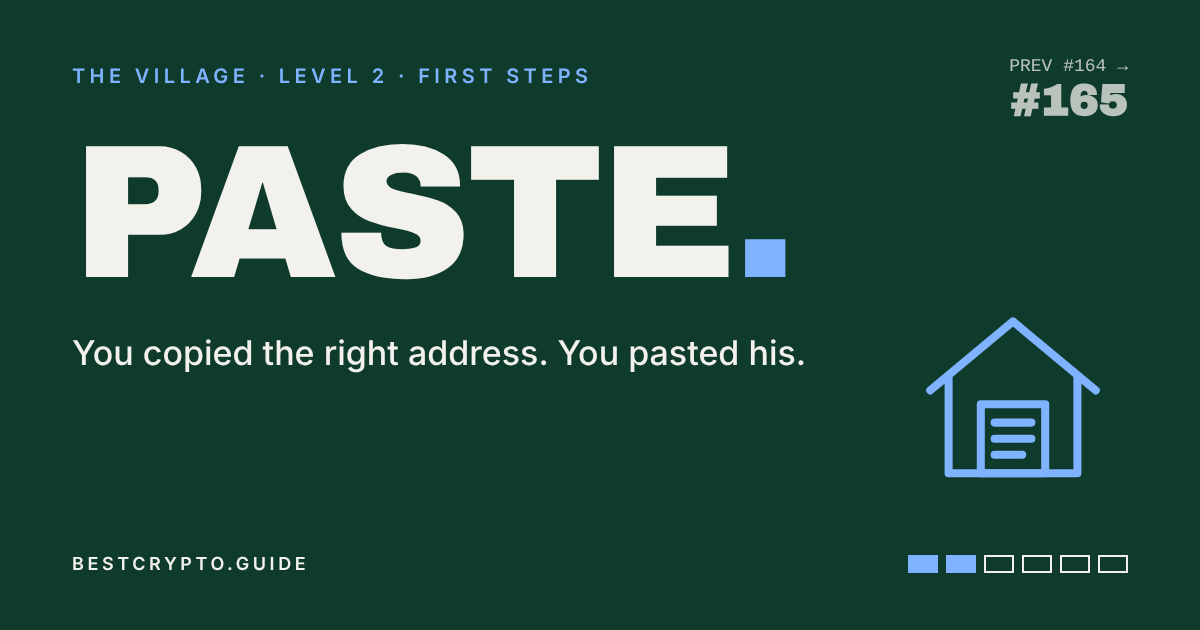
Imagine a lodger in your house you never invited and never see. He doesn't touch your money. He waits until you copy an address from a letter onto an envelope, and while you reach for a stamp, he rewrites it.
You post the letter. The village notebook records that you paid, which is true. It also records who you paid, and that's the lodger. Nobody can tear out the page.
That's a clipboard hijacker, one of the two kinds of malware that matter most in crypto. The other kind doesn't wait for a payment at all: it copies your keys and leaves.
What it is
Malware is software that runs on your device and works for someone else. In crypto, two families do most of the damage.
- Stealers (infostealers) search your computer or phone for passwords, browser data, wallet files and seed phrases, then send them to their operator.
- Clipboard hijackers (clippers) watch what you copy. When the copied text looks like a crypto address, they replace it with the attacker's.
This is different from address poisoning, covered in QR codes and address poisoning, where a look-alike is planted in your transaction history. A clipper needs no look-alike. You copy the right address from the right source, and the swap happens inside your own machine between copy and paste.
How it works: one payment, one swap
Here is the clipper, step by step, with a real one in mind.
- The infection. The software arrives hidden in something you installed, often a free program, a cracked game or a fake app. You notice nothing.
- The watch. It sits in the background and checks your clipboard. A Bitcoin or Ethereum address has a recognisable shape, so it's easy to spot.
- The copy. You copy your friend's address from her message. Correct, letter for letter.
- The swap. In that instant the clipper puts its owner's address into the clipboard instead.
- The paste and the signature. You paste, glance at it, sign. The notebook writes the line, permanently.
That isn't a thought experiment. On 1 September 2026, the US Justice Department announced the disruption of Sality, malware that had been spreading since 2003 and was "enabling cryptocurrency theft" (US Attorney, Central District of California). The security firm CrowdStrike, which took part, says one of its payloads, EggJagger, "monitors the clipboard for cryptocurrency wallet addresses" and swaps in the operator's own. CrowdStrike counted over 33,000 infected machines and estimates the operator stole at least 12.1 million roubles, about $150,000, through that one payload. Those are the company's own figures (CrowdStrike, 31 August 2026).
Phones aren't immune. On 1 February 2019 a fake app posing as the MetaMask wallet appeared on Google Play. The security firm ESET found that it could "replace a Bitcoin or Ethereum wallet address copied to the clipboard with one belonging to the attacker", and Google removed it after ESET reported it (ESET, 8 February 2019).
Stealers work on a larger scale. Between 16 March and 16 May 2025, Microsoft identified over 394,000 Windows computers infected with a stealer called Lumma, which "steals passwords, credit cards, bank accounts, and cryptocurrency wallets" (Microsoft, 21 May 2025). The Justice Department seized its control domains in May 2025. The FBI listed "cryptocurrency seed phrases" among its targets and found "at least 1.7 million instances" of Lumma stealing such information (DOJ, 21 May 2025).
Why it matters
Malware turns your own device into the stranger at the gate. Every other check in this section assumes the screen in front of you tells the truth. Malware is the one attack where it might not.
It's also a business. The Justice Department says Lumma's administrators distributed it "to their affiliates and other cyber criminals". Someone writes the lodger once, and rents him out to many houses.
The reported losses look small next to the infection counts. The FBI's complaint centre logged 893 malware complaints with losses of about $19.4 million in 2025 (FBI IC3, 2025 report). That counts only people who knew malware was the cause, and reported it. The DOJ notes that owners of Sality-infected machines were "typically unaware".
Where people get it wrong
- "I copied it, so it's right." The copy was right. What counts is what you pasted.
- "I'd notice a virus." Good malware is built not to be noticed. Its business model depends on it.
- "It's in the official app store, so it's safe." The fake MetaMask app was on Google Play.
- "My seed phrase is safe as a photo or a note in my cloud." Stealers go looking for exactly that.
- "I check the first four characters." A clipper's address doesn't need to look like yours. You're more likely to catch it, but only if you read past the start, as our article on the 4-character habit explains.
Read after you paste
Make one habit stick: compare the address you pasted with the source, start, middle and end, before you sign. For larger amounts, confirm it on a hardware wallet's own screen, which malware on your computer can't rewrite. Keep your seed phrase on paper or metal, never in a photo, a note or a file. Install wallets and software only from the maker's own site or its verified store page, and skip the free cracked version of anything.
The lodger is fast, quiet and patient. He has one weakness: he counts on you to copy, paste and sign without reading. Read.
Frequently asked questions
What is a clipboard hijacker?
A clipboard hijacker, or clipper, is malware that watches what you copy on your computer or phone. When it sees something that looks like a crypto address, it replaces it with an address controlled by the attacker. If you paste and send without checking, the coins go to the attacker.
How can I tell if my clipboard has been hijacked?
Paste the address and compare it with the original, character by character at the start, middle and end. If the pasted address differs from the one you copied, stop, don't send, and treat the device as infected. Use a different, clean device and have the infected one checked or reset.
What is an infostealer?
An infostealer is malware that searches a device for valuable data, such as saved passwords, browser cookies, wallet files and seed phrases, and sends it to the attacker. Microsoft found one stealer, Lumma, on over 394,000 Windows computers in two months of 2025. A stolen seed phrase gives the thief full control of the wallet.
Does a hardware wallet protect against malware?
It helps a lot. The keys stay on the device, and the address you're sending to is shown on the hardware wallet's own screen, which malware on your computer can't change. It only protects you if you actually read that screen before confirming.
How does crypto malware get onto a device?
Mostly through things people install or click on: free or cracked software, fake apps, malicious adverts and phishing emails. Microsoft says the Lumma stealer was spread through spear-phishing emails and malvertising and impersonated trusted brands. Installing only from the official maker and keeping your system updated closes most of these doors.
Sources
- US Attorney's Office, Central District of California, Sality malware disrupted in international cyber takedown (1 September 2026)
- CrowdStrike, Peer pressure: inside the Sality botnet disruption operation (31 August 2026)
- ESET WeLiveSecurity, First clipper malware discovered on Google Play (8 February 2019)
- US Department of Justice, Justice Department seizes domains behind major information-stealing malware operation (21 May 2025)
- Microsoft On the Issues, Disrupting Lumma Stealer: Microsoft leads global action against favored cybercrime tool (21 May 2025)
- FBI Internet Crime Complaint Center, 2025 Internet Crime Report