What is cryptocurrency? A notebook in every house, and no keeper
A cryptocurrency is digital money recorded in a shared ledger that thousands of computers keep and check together. No bank keeps the book; the rules are written into software that anyone can run.
Grandma Rosa stops Anna at the well. "Everyone keeps saying crypto," she says. "Is it a coin? Can I hold it? Where do they keep it?"
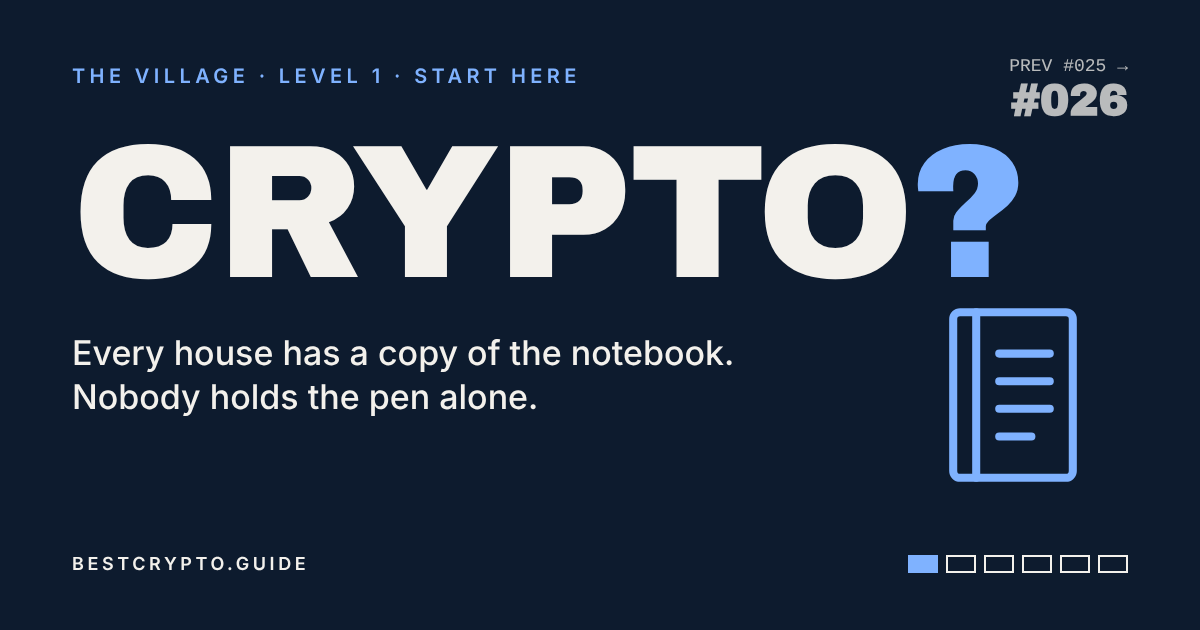
Anna points down the lane. "You know the village notebook, the one where we write who owes what? Imagine every house had its own copy. Every time someone pays, every house writes the same line. If one copy says something different, the others outvote it."
"So who keeps the notebook?" asks Rosa. "Everyone," says Anna. "Which means nobody can tear out a page on their own." That is cryptocurrency: money that lives as lines in a shared notebook, with no single keeper.
What it is
A cryptocurrency is a digital currency recorded on a shared ledger, usually a blockchain, that many independent computers keep and check together. The "crypto" part is cryptography: maths that lets you prove a coin is yours without showing anyone your key.
The idea was first made to work in the Bitcoin white paper of 2008. Its opening line describes "a purely peer-to-peer version of electronic cash" that lets payments go "directly from one party to another" without a financial institution in the middle (Nakamoto, 2008).
EU law uses a wider word. Under the MiCA regulation, a crypto-asset is "a digital representation of a value or of a right that is able to be transferred and stored electronically using distributed ledger technology or similar technology" (MiCA, Article 3; readable version: ESMA rulebook). MiCA has applied in full since December 2024 (ESMA).
How it works
Follow one payment through the village. Anna wants to pay Rosa 0.01 bitcoin for a scarf.
- Anna signs. Her wallet app writes a message: "move 0.01 from Anna's address to Rosa's". It signs it with Anna's private key, a secret number only she has. The signature proves the message came from her, without revealing the key.
- Anna shouts it to the village. The wallet sends the message to a few computers running Bitcoin software, the nodes. They pass it on to others. Within seconds, thousands of copies have heard it.
- Every house checks. Each node asks two questions. Does Anna's address really hold 0.01 bitcoin? Has she already spent it somewhere else? If either answer is wrong, the message is dropped.
- Someone writes the page. Miners collect waiting payments into a block, a new page of the notebook. Bitcoin's software aims for one block every ten minutes; the rule is written as
10 * 60seconds in the code (Bitcoin Core). - The writer gets paid in new coins. Here is a real page. Block 840,000 was mined on 20 April 2024. It held 3,050 transactions. Its miner received 3.125 brand-new bitcoin, plus 37.6 bitcoin in fees paid by the people whose payments were on the page (mempool.space).
- The page is glued in. Every node checks the new block and adds it to its copy. Each block points to the one before it, so changing an old page would mean rewriting every page after it, in more houses than you can bribe.
The new coins follow a fixed schedule. The reward halves every 210,000 blocks (Bitcoin Core). The code caps the number at 21 million bitcoin, and its own comment notes that the real supply will end up a little below that (Bitcoin Core).
Anna never touched a bank. Rosa never had to trust Anna's word. She only had to trust that most houses copy honestly.
Why it matters
- No keeper can freeze the book. On a network like Bitcoin, no single company can close your page or reverse your payment.
- No keeper can rescue you either. If you send coins to the wrong address or lose your key, there is no help desk. The village doesn't tear out pages for anyone.
- The rules are public. The supply schedule is in code anyone can read. Compare that with a central bank, where the people with the pen decide.
- The price is not in the code. Nothing in the software says what a bitcoin is worth. EU regulators warned in March 2022 that consumers face "the very real possibility of losing all their invested money" and called many crypto-assets "highly risky and speculative" (ESMA, EBA and EIOPA, 2022).
Where people get it wrong
- "My coins are in my wallet." They aren't. The coins are lines in the shared notebook. Your wallet holds the key that lets you sign them away.
- "Crypto means Bitcoin." Bitcoin was the first. There are thousands of others, built in different ways, some with a keeper after all.
- "Nobody runs it, so nobody is responsible." Developers, miners, exchanges and regulators all have a say. Nobody has the whole say.
- "Digital means it can be copied." Copying a coin is exactly what the shared notebook stops. Every house would notice the same line spent twice.
Try reading a page yourself
Open a block explorer such as mempool.space and look at any block. You'll see the time, the number of payments and the new coins the miner got. No login, no permission, no fee.
That's the whole point of the village notebook: anyone can read it. The stranger at the gate who says his coin "lives on the blockchain" won't mind if you check. And if he minds, you've learned something.
Frequently asked questions
What is cryptocurrency in simple terms?
Cryptocurrency is digital money recorded in a shared ledger that many independent computers keep and check together. No single bank or company keeps the book. The rules for who can spend what are enforced by software and cryptography.
Who invented cryptocurrency?
The first working cryptocurrency was Bitcoin, described in a 2008 white paper published under the name Satoshi Nakamoto. Earlier digital cash ideas existed, but Bitcoin was the first to work without a central keeper.
How is a crypto-asset defined in EU law?
The EU's MiCA regulation defines a crypto-asset as a digital representation of a value or a right that can be transferred and stored electronically using distributed ledger technology or similar technology. MiCA has applied in full since December 2024.
Where are my crypto coins actually stored?
On the blockchain itself, as entries in the shared ledger. Your wallet stores the private key that lets you move them. Lose the key and the coins stay in the ledger, but nobody can spend them.
How are new bitcoins created?
Miners who add a new block receive newly created bitcoin plus the fees in that block. Since April 2024 the reward has been 3.125 bitcoin per block, and it halves every 210,000 blocks. The total is capped at 21 million.
Is cryptocurrency safe to invest in?
Prices can fall sharply and you can lose everything you put in. EU regulators warned in March 2022 that many crypto-assets are highly risky and speculative. This site explains how crypto works; it doesn't recommend buying any.
Sources
- Satoshi Nakamoto, Bitcoin: A peer-to-peer electronic cash system (2008)
- Regulation (EU) 2023/1114 on markets in crypto-assets (MiCA), Official Journal, EUR-Lex
- ESMA, Interactive single rulebook: MiCA Article 3, Definitions (Regulation (EU) 2023/1114)
- ESMA, Markets in Crypto-Assets Regulation (MiCA)
- Bitcoin Core, src/kernel/chainparams.cpp (mainnet consensus parameters)
- Bitcoin Core, src/consensus/amount.h (MAX_MONEY)
- mempool.space, Bitcoin block 840,000 (20 April 2024)
- ESMA, EBA and EIOPA, EU financial regulators warn consumers on the risks of crypto-assets (17 March 2022)