Coin vs token: one owns the notebook, the other rents a page
A coin is the native money of its own blockchain, like bitcoin or ether. A token is created by a program on someone else's blockchain, and often has an issuer who can change the rules for it.
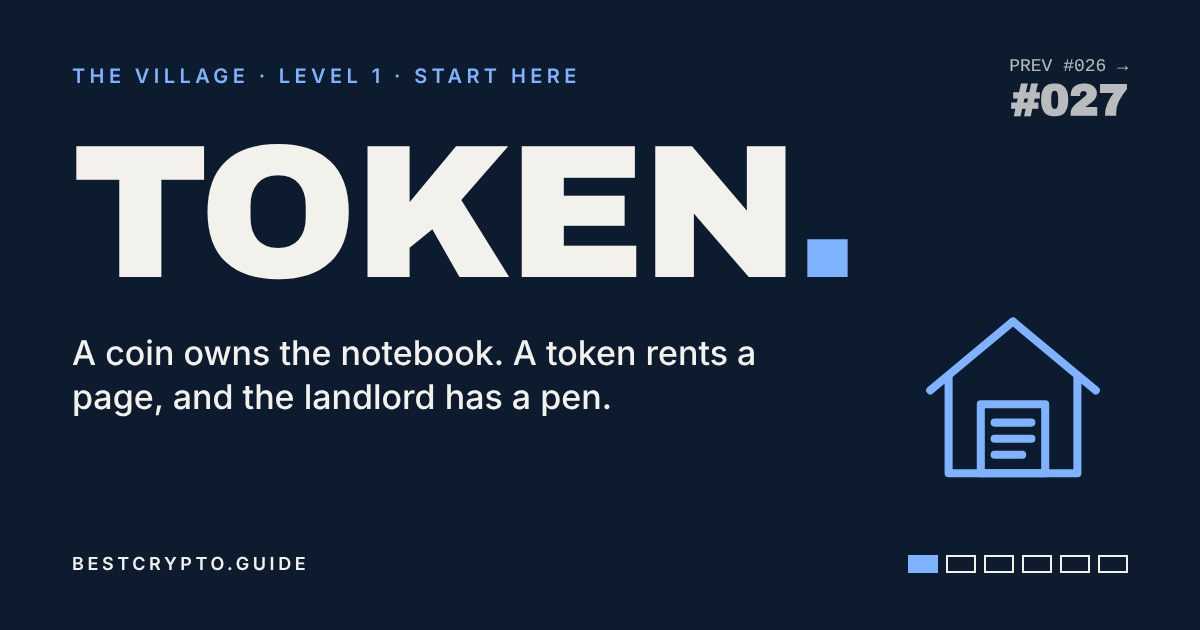
The village notebook has its own money: the lines everyone writes when they pay each other. Call them village coins. Every house keeps them, and the miners who copy the pages get paid in them.
One spring the miller has an idea. He'll write his own flour vouchers into the village notebook. Ten vouchers, one sack of flour. People can swap them like coins, and every house records the swaps.
There's a catch Grandma Rosa spots at once. "The notebook belongs to the village," she says. "But the vouchers belong to the miller. What if he stops honouring them?" That's the difference between a coin and a token.
What it is
A coin is the native money of a blockchain. Bitcoin on the Bitcoin network, ether on Ethereum. It's built into the rules of the network itself, and it's what you pay the network's fees in.
A token is created by a program, a smart contract, that runs on an existing blockchain. It borrows that chain's notebook. It doesn't have its own. On Ethereum, most tokens follow a shared template called ERC-20, which ethereum.org describes as a standard that "implements an API for tokens within Smart Contracts" (ethereum.org). The template was written up in November 2015 by Fabian Vogelsteller and Vitalik Buterin (EIP-20).
Tokens can stand for almost anything. Ethereum's own list includes "reputation points in an online platform", "a fiat currency like USD" and "an ounce of gold" (ethereum.org).
How it works
Take one real token: USDC, a dollar stablecoin issued by the company Circle, as it sits on Ethereum.
- It lives at an address. USDC on Ethereum is a smart contract at
0xA0b86991c6218b36c1d19D4a2e9Eb0cE3606eB48. On 18 November 2026, Etherscan showed a supply of about 44.7 billion USDC and about 9.2 million holders on this one contract (Etherscan). - It's a list inside a program. The contract keeps a table: address, balance. The ERC-20 template gives it standard functions such as
balanceOfandtransfer(EIP-20). Wallets know how to read those, which is why one wallet can show thousands of tokens. - Moving it costs the coin, not the token. Say Anna sends Rosa 100 USDC. The contract updates its table. But the fee for running that update must be paid in ether: "Gas fees have to be paid in Ethereum's native currency, ether (ETH)" (ethereum.org). Anna can hold a thousand USDC and still be stuck if she has no ether.
- The issuer keeps a pen. Circle's terms say it "reserves the right to block the transfer of USDC to and from an address on chain" and to "freeze associated USDC (temporarily or permanently)" (Circle, USDC terms). Nobody can freeze your ether that way, because no company issues ether.
- The issuer also makes a promise. Since 1 July 2024, Circle has issued USDC in the EU under an e-money licence, and holders have "the right of redemption against the issuer at any time and at par value" (Circle, 2024).
The miller's vouchers, exactly. The village records them. The miller decides what they're worth and whether they still move.
What the law calls them
EU law doesn't use "coin" and "token" the way the industry does. MiCA sorts crypto-assets by what they promise (MiCA, Article 3; readable version: ESMA rulebook):
- An e-money token "purports to maintain a stable value by referencing the value of one official currency". USDC is one.
- An asset-referenced token tries to stay stable by referencing another value or right, or a mix of them, for example several official currencies.
- A utility token is "only intended to provide access to a good or a service supplied by its issuer".
Bitcoin falls in none of these three. It's simply a crypto-asset with no issuer to make any promise at all.
Why it matters
- Who can change the rules. A coin's rules change only if the network agrees. A token's rules can often be changed by whoever controls its contract.
- Who you're trusting. Holding a token means trusting the issuer as well as the blockchain. Two risks, not one.
- What you need in your wallet. Tokens need the chain's coin for fees. Many beginners learn that the hard way.
Where people get it wrong
- "Coin and token mean the same thing." In everyday chat, often. In how they work, no: one is native, the other is a program's entry.
- "A token is safe because it's on a big blockchain." The blockchain is the paper. The issuer is who wrote the line. A strong notebook can hold a worthless voucher.
- "If it's called a coin, it's a coin." Plenty of tokens have "coin" in their name. The name is marketing. The contract address is the fact.
- "Nobody can freeze crypto." Nobody can freeze bitcoin centrally. Many tokens, including the large stablecoins, can be frozen by their issuer.
Ask who holds the pen
Before you accept any token, ask one question: who can change it? Look up the issuer, the contract and the terms. If there's a company, read what it may freeze, mint or cancel.
The miller's vouchers are fine while the miller is honest. The stranger at the gate is also offering vouchers. Ask him which mill.
Frequently asked questions
What is the difference between a coin and a token?
A coin is the native currency of its own blockchain, such as bitcoin or ether, and pays that network's fees. A token is created by a smart contract on an existing blockchain. Tokens often have an issuer who controls the contract.
Is ether a coin or a token?
Ether is a coin. It is the native currency of Ethereum and is used to pay gas fees. The thousands of tokens that run on Ethereum depend on ether to move.
What is an ERC-20 token?
ERC-20 is a standard template for fungible tokens on Ethereum, set out in EIP-20 in November 2015. It defines common functions such as checking a balance and sending tokens, so wallets and apps can handle any ERC-20 token the same way.
Why do I need ether to send a token?
Every action on Ethereum, including moving a token, uses computing work that must be paid for in gas. Gas fees on Ethereum are paid in ether. Without ether in the same wallet, the token can't be moved.
Can a token be frozen?
Some can. Circle's USDC terms reserve the right to block addresses and freeze USDC. Whether a token can be frozen depends on how its contract was written, so check before you hold it.
What is an e-money token under MiCA?
Under the EU's MiCA regulation, an e-money token is a crypto-asset that aims to keep a stable value by referencing one official currency, such as the euro or the US dollar. Circle, which issues USDC as an e-money token, states that holders have the right to redeem against the issuer at any time and at par value.
Sources
- ethereum.org, ERC-20 token standard
- Fabian Vogelsteller and Vitalik Buterin, EIP-20: Token Standard (created 19 November 2015)
- ethereum.org, Gas and fees
- Etherscan, USDC token contract on Ethereum (read 18 November 2026)
- Circle, Circle is first global stablecoin issuer to comply with MiCA, EU's landmark crypto law (1 July 2024)
- Circle, USDC terms (updated 15 October 2026)
- Regulation (EU) 2023/1114 on markets in crypto-assets (MiCA), Official Journal, EUR-Lex
- ESMA, Interactive single rulebook: MiCA Article 3, Definitions (Regulation (EU) 2023/1114)